
10/10
Here is a movie that does something Indian blockbuster cinema doesn’t do too often: it takes itself seriously. A spy thriller with rules, with craft, with a high level of suspense and attention to detail. Dhurandhar is three and a half hours of controlled escalation, a film built like a video game where each level brings a more dangerous boss and higher stakes. It is the film that puts Indian cinema on the global thriller map, and represents the absolute pinnacle of Bollywood filmmaking. Akshaye Khanna turns in one of the all-time performances in cinema history. Shashwat Sachdev’s soundtrack is the first Bollywood album to land every track simultaneously on the Spotify Global Top 200. The innovative score jumps between rock, nostalgic Hindi, and a fusion techno-modern Indian sound with English samples.
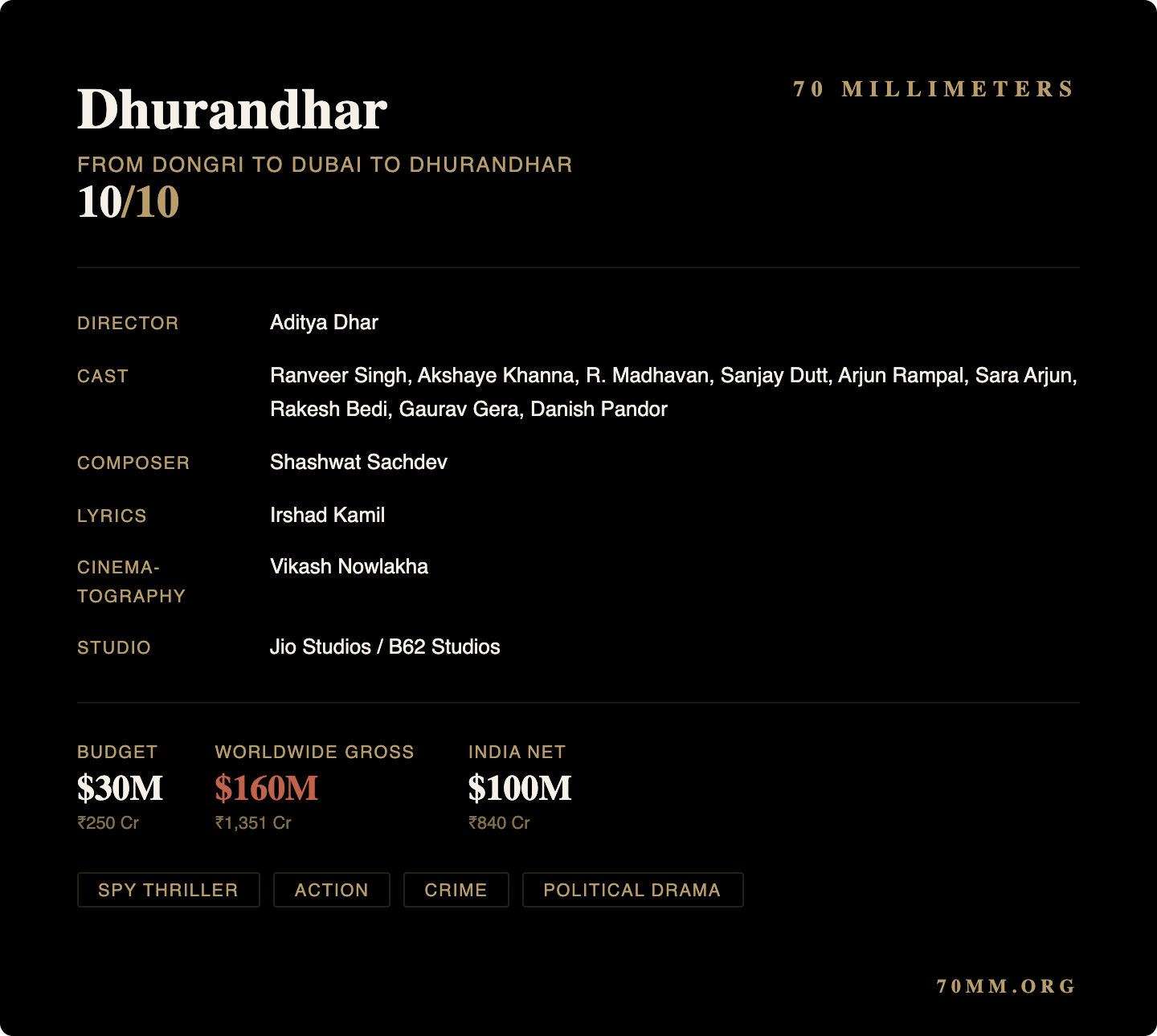
Dhurandhar is one of the greatest movies I’ve ever seen. A definitive gangster-spy thriller: a stylistic mashup of a counterterrorism/spy movie with Godfather style family dynamics and Scorsese-inspired mafia drama, with Quentin Tarantino’s gore.
Often Indian films feel like plays. They have the wink, the self-awareness, the Bollywood handshake where everyone agrees they’re performing for an audience. That kills the immersion for more seasoned, sophisticated viewers. Dhurandhar takes itself seriously in a way that Indian cinema almost never does. Every frame. Every silence. Every lit cigarette. This is a movie that can be enjoyed by global audiences. Don’t compare it to other Indian movies spoken about in a similar vein like Baahubali or RRR. Those are still over the top in nature and don’t come close.
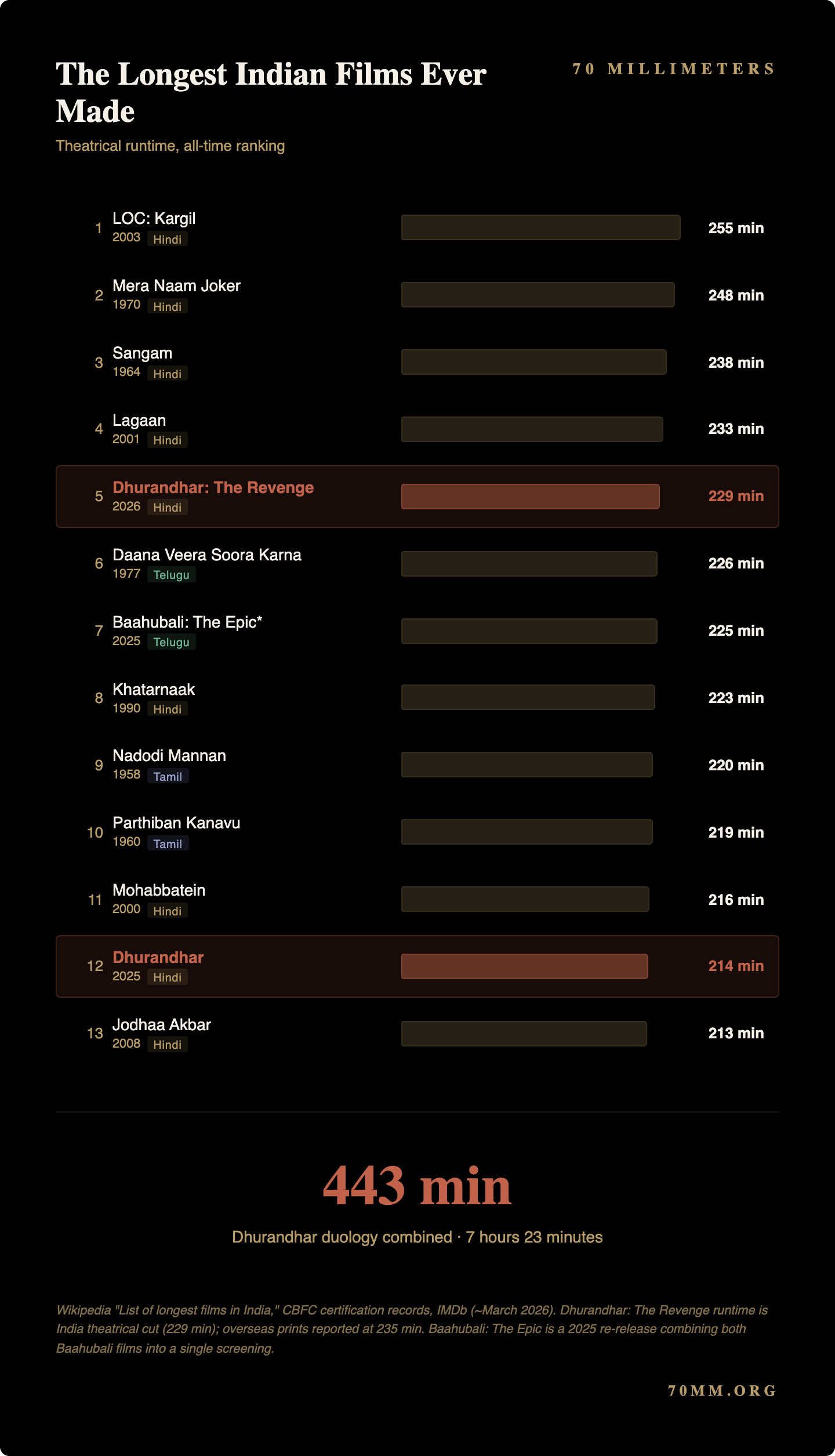
The whole film feels groovy. Modern. It has a swagger and a rhythm that I associate with the best American gangster thrillers, except the texture is entirely Indian & Pakistani. Could you cut five or ten minutes here and there? Probably. But everything in there earns its place. It gives the film a style, a willingness to breathe, to let scenes linger until the tension has nowhere left to go. At 214 minutes, the longest Bollywood release in 17 years until its sequel, this is a film that knows it’s long and makes a case for every minute.
Ranveer Singh plays Jaskirat Singh Rangi, a RAW agent who crosses into Pakistan posing as a Baloch man named Hamza Ali Mazari. He enters Lyari, the beating criminal heart of Karachi, and works his way from the absolute bottom. A waiter. A guy who keeps his head down and watches. The film unfolds in chapters, each one a rung on a ladder: local gangs, local politicians, national politicians, ISI. The level-to-level progression gives the film a propulsive video game quality. You clear one boss, and the next one’s already watching you.
And the irony running through every rung is delicious. A politician who thinks he’s manipulating Rahman Dakait doesn’t realize Rahman is three moves ahead. Ranveer’s character is constantly pretending to be Baloch, and Rahman thinks he’s sincere. The ISI handler thinks he can outplay Rahman, and Rahman is quietly guarded. Everyone in this film is playing a game inside a game. This is what a world without rules looks like.
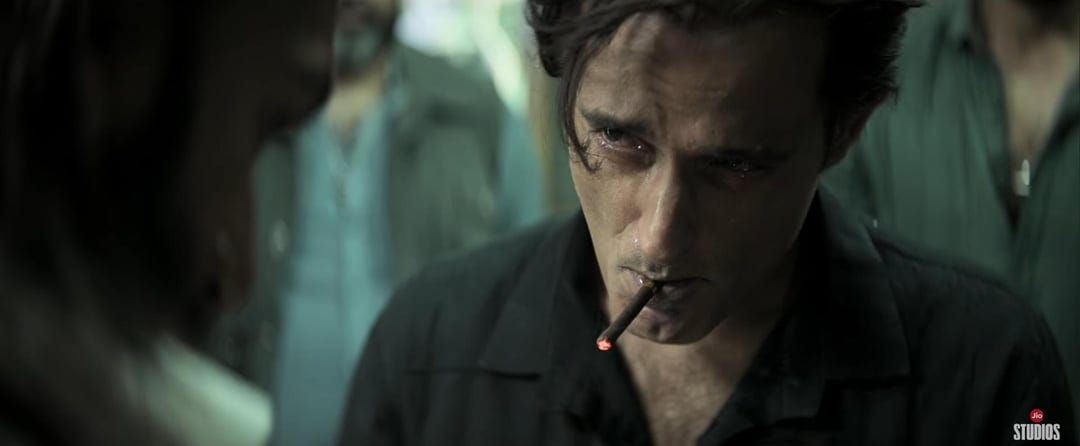
Akshaye Khanna puts in one of the all-time great performances as a villain.
His Rahman Dakait has infinite aura. Watch what happens when he enters a room. The film slows down. People stop talking. He doesn’t raise his voice often, and when he does, the room has already been his for minutes. His nonverbal work is absurd. His facial expressions. His frowns. His smiles. His eyebrows. The pauses between words carry as much information as the words themselves. He’s terrifying yet magnetic, a gangster-politician-philosopher. Khanna has been playing versions of this character across his career, but this feels like the culmination. The story of the casting is worth telling:
Casting director Mukesh Chhabra proposed Khanna for the role. Aditya Dhar thought he was being overly ambitious. Khanna’s first reaction on the phone was to scold Chhabra. Then Chhabra convinced him to at least hear the script. Khanna showed up, sat for four hours, chain-smoked, barely interrupted. When the narration ended, he broke the silence: “F**k, it’s very good. This will be a lot of fun. ” Two anxious days later, Chhabra’s phone rang. “Let’s do it, bro.” That was it.
In a serious world, Khanna wins an academy award for Dhurandhar. Easily. He was that good. But the academy isn’t driven by merit.
Ranveer Singh locks in. This is a subtle Ranveer performance. We look to his eyes and facial expressions for information. His character’s survival depends on stillness, on watching, on absorbing information without reacting. The moments where Rahman notices something flicker across Ranveer’s face and asks what’s on his mind are masterpieces of tension. Ranveer gives him some smooth deflection about what he’s thinking. You hold your breath.
Madhavan plays IB Director Ajay Sanyal, the man running the operation from India, inspired by India’s Security Advisor Ajit Doval. His recurring philosophy of “collect evidence, wait till someone new comes to power, our time will come” is reflective of the mindset of the country. India had repeatedly been let down by its leaders for decades. Their spineless leaders repeatedly sold out to foreign powers and destroyed the country’s economy. Madhavan starts out in an era where India is busy self-sabotaging itself.
India's biggest enemies are Indians themselves. Pakistan comes second. — Ajay Sanyal
Sanjay Dutt as SP Choudhry Aslam is outstanding with swagger and menace. His character was a real person in Lyari, who actually fought against gangs and tried imposing law and order.
“You sparked a flame and thought that you had brought the fire under control ... don't live under that illusion ... because I'm a heap of gunpowder meant to turn people like you into ashes.” — SP Choudhry Aslam
Arjun Rampal as the ISI agent Major Iqbal is ridiculous in the best way. His interrogation scene has an intensity that makes you uncomfortable in your seat.
Even the smaller players land. Sara Arjun looks the part. Her discussion of “burger bacche,” a real Karachi term for the wealthy westernized class, and the restrictions placed on political families and the detail about her father’s age gap with her mother, feel like they were written by someone who actually knows Pakistan. The Lyari Task Force subplot gives the film a street-level grit that the espionage plot needs.
“Do you know what is the most beautiful habit of destiny ... it changes when the time comes.” — Ajay Sanyal
The casting choices were excellent. The makeup and hairstyles even moreso. Sara Arjun’s facial features and hair read more northern, more Pakistani. The crowds of Lyari are populated with extras who add raw realism. Dhar shot in Thailand as a stand-in for Karachi, and the film is smart about its limitations. How much of Thailand can you show before it obviously isn’t Lyari? A decent amount, but not too much. So the film leans into the people instead. The gangsters, the bystanders, the media voiceover of a woman discussing Rahman’s rise to power.
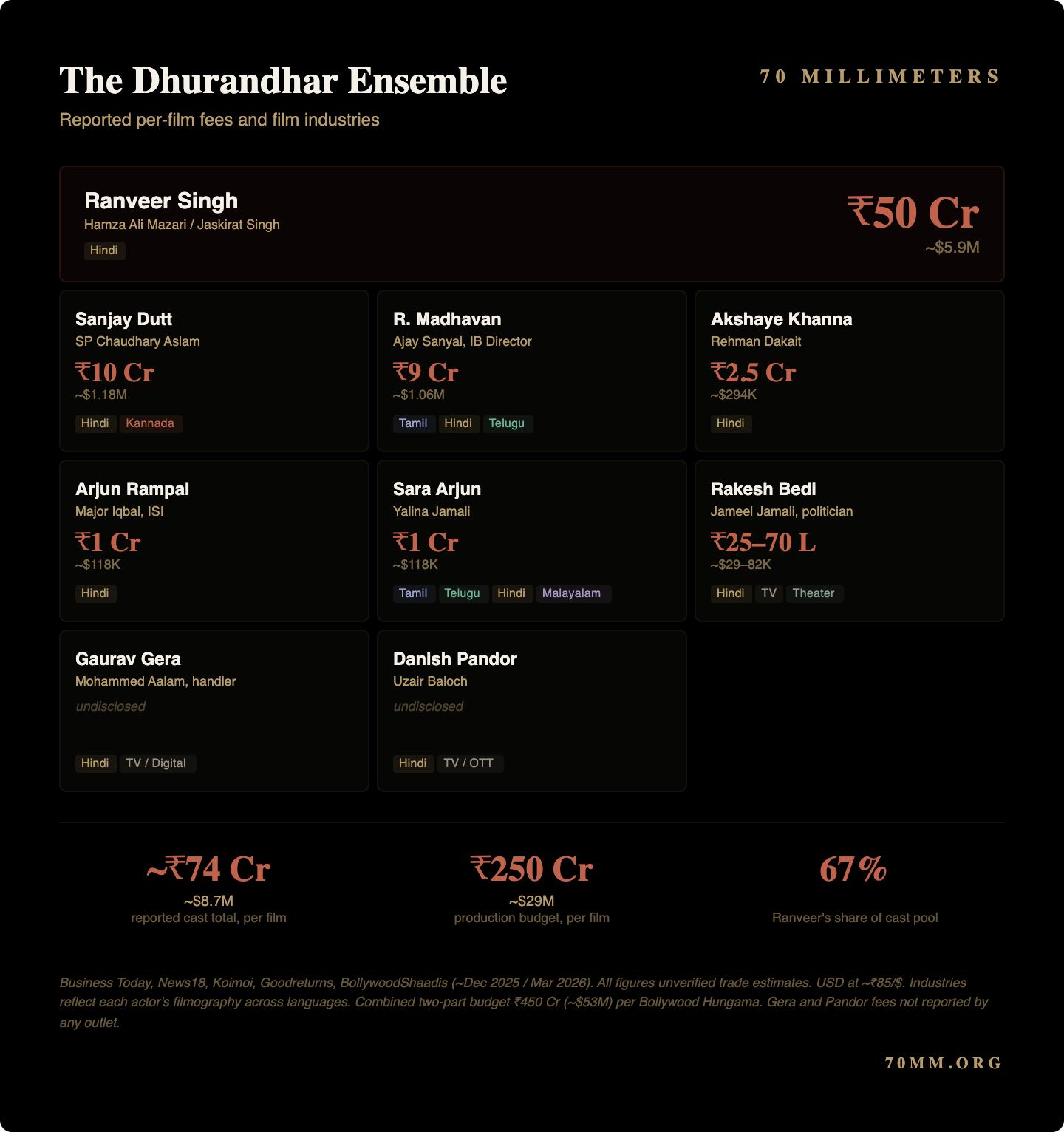
In totality, the cast was among the strongest ever seen in Indian cinema:
The story reveals an interesting slice of life in the subcontinent. India is somewhat Balkanized. Everyone knows this. But Pakistan, despite the guise of Islam as a unifying force, is far more fractured. Pashtuns. Balochs. Sindhis. The movie does a great job portraying the inter-tribal conflicts and tensions.
The film has arguably the best depiction India-Pakistan conflict ever. The rivalries and intensity of hatred are made clear. Pakistan is shown as a place where the state, the military, the intelligence apparatus, the crime syndicates, and the religious establishment all operate on different agendas that occasionally align and frequently don’t. The word “kaafir” gets deployed in the film the way it gets deployed there in real life: as a weapon of convenience, a label that shuts down conversation and justifies whatever comes next, including terrorism. Ranveer’s desire for justice is representative of the Indian mindset as of late. This is a great movie for anyone who wants to understand the extent of the tensions between both countries.
“I am lethal because I am wounded.” — Hamza Ali Mazari / Jaskirat Singh
There’s a scene where Ranveer calls the cops on a group of rich kids at a club, and Ranveer promises the officers millions. It’s a small subplot, but it captures something about Pakistan’s social contradictions. Clubbing and drinking are culturally forbidden under Islam. Everyone knows it happens. The wealthy do it openly. And when something goes wrong, the parents pay off the police and the whole thing disappears. That’s Pakistan.
The film puts real historical events on screen with unbelievable accuracy. The level of research was simply meticulous. The hijacking of Indian Airlines 814 opens the movie up. The 2001 Parliament attack sets the tone. The illegal currency note facilitation that contributed to 26/11 is eerily accurate. The scamming politician P. Chidambaram’s alleged role in that scam appears, mildly disguised but recognizable. The corrupt nature of the Indian state of Uttar Pradesh, and how it’s used to launch Pakistani operations in India, repeatedly rears its head. Javed Khanani was actually bankrolling the ISI, as depicted in the movie. David Headley and Ajmal Kasab both get depictions, and I recognized Kasab the second he appeared, before the movie told you. You could feel it in the youthfulness of his face, the same face you saw on TV in 2008.
I am impressed at how accurately the scripting weaves everything. In 2006, when P. Chidambaram was India’s Finance Minister, Arvind Mayaram was Joint Secretary and Ashok Chawla Additional Secretary, they carved out the Security Printing & Minting Corporation of India (SPMCIL) and started buying security printing paper exclusively from Britain’s De La Rue, the same firm Pakistan was already using. Intelligence alerts made clear how this single-source arrangement handed counterfeiters the exact materials they needed to flood India with near-perfect fakes that propped up Pakistan’s economy for years. When he ascended to Finance Minister in 2010, Pranab Mukherjee blacklisted De La Rue on those very warnings. Then Chidambaram returned as Finance Minister in 2012 and the UPA quietly reversed the ban, with Mayaram’s office restarting the purchases. It took Narendra Modi becoming Prime Minister in 2014 to shut the tap for good and trigger the investigations that eventually led to the CBI FIR against Mayaram for the dubious extensions.
The 26/11 attacks - India’s equivalent of 9/11 - being shown on screen, as part of the story, as a result of internal sabotage and the currency printing scheme, along with the recording of Pakistani intelligence handlers guiding the terrorists was a powerful moment. You knew that’s how it played out in 2008.


The general ridicule of Pakistani politicians and the way they sell out to various interests is something you can appreciate regardless of where you sit politically. The minister with a bet on a cricket match. The line about failing 8th grade and still wanting to become a politician. These moments are darkly funny and grounded.
“Anyone who’s climbed to the top of Pakistani politics has got their hands dirty.”
This wouldn’t have been made in the old Bollywood. S. Hussain Zaidi documented the Mumbai mafia’s arc in his book Dongri to Dubai, tracing how the infamous gangster Dawood Ibrahim built an empire from a small neighborhood to the skyscrapers of the Gulf. But the book’s most unsettling detail was Dawood’s reach into Bollywood. The money laundering through production houses, the coercion of producers and stars, the hits on people who didn’t comply, the way drug money fueled it all. For decades, organized crime and Pakistani intelligence interests shaped what stories got told and which ones didn’t. Films that softened Pakistan’s image got greenlit and bankrolled. Films that didn’t got buried. Dhurandhar takes that arc further. The film is what happens when a country decides it’s done being passive, and when an industry finally makes movies that serve its own national interests unshackled by subversive foreign influences. The line that rattled around in my brain:
“This is the new India. We barge into your homes and take you out.” — Hamza Ali Mazari / Jaskirat Singh Rangi
You see in the 2000s, Indian cities were getting hit almost monthly. Delhi. Mumbai. Jaipur. Ahmedabad. Hyderabad. Varanasi. Bangalore. Bomb after bomb after bomb, and the geopolitical reality behind many of them traced back across the border into Pakistan. This is the decade the film lives in. It trusts you to remember what it felt like to turn on the news and see another city burning, another market shredded, another train ripped apart, another family mourning, with shameless politicians blaming it on their own. Dhurandhar doesn’t explain this. It assumes you were there, or that you’ve read enough to understand why an entire generation stopped believing in restraint. For those who are uninformed, perhaps this comes across as propaganda. But it’s the truth.
India still has a long road ahead. But the turnaround in national security and raw, unapologetic sovereignty under Narendra Modi is decisive and undeniable. Dhurandhar is the first half of a hard-won, deserved victory lap. It remembers the years when the country was run by people like Manmohan Singh and the delusional Rahul Gandhi: corrupt sellout frauds who were willing to accommodate the very extremists chipping away at it from within. The film doesn’t shy away from saying the quiet part out loud: enough was finally enough. And in Ranveer Singh’s undercover shadow war across Karachi and Lyari, you feel every ounce of that pent-up national resolve finally being unleashed. Dhurandhar is a way for a billion people to process their generational trauma.
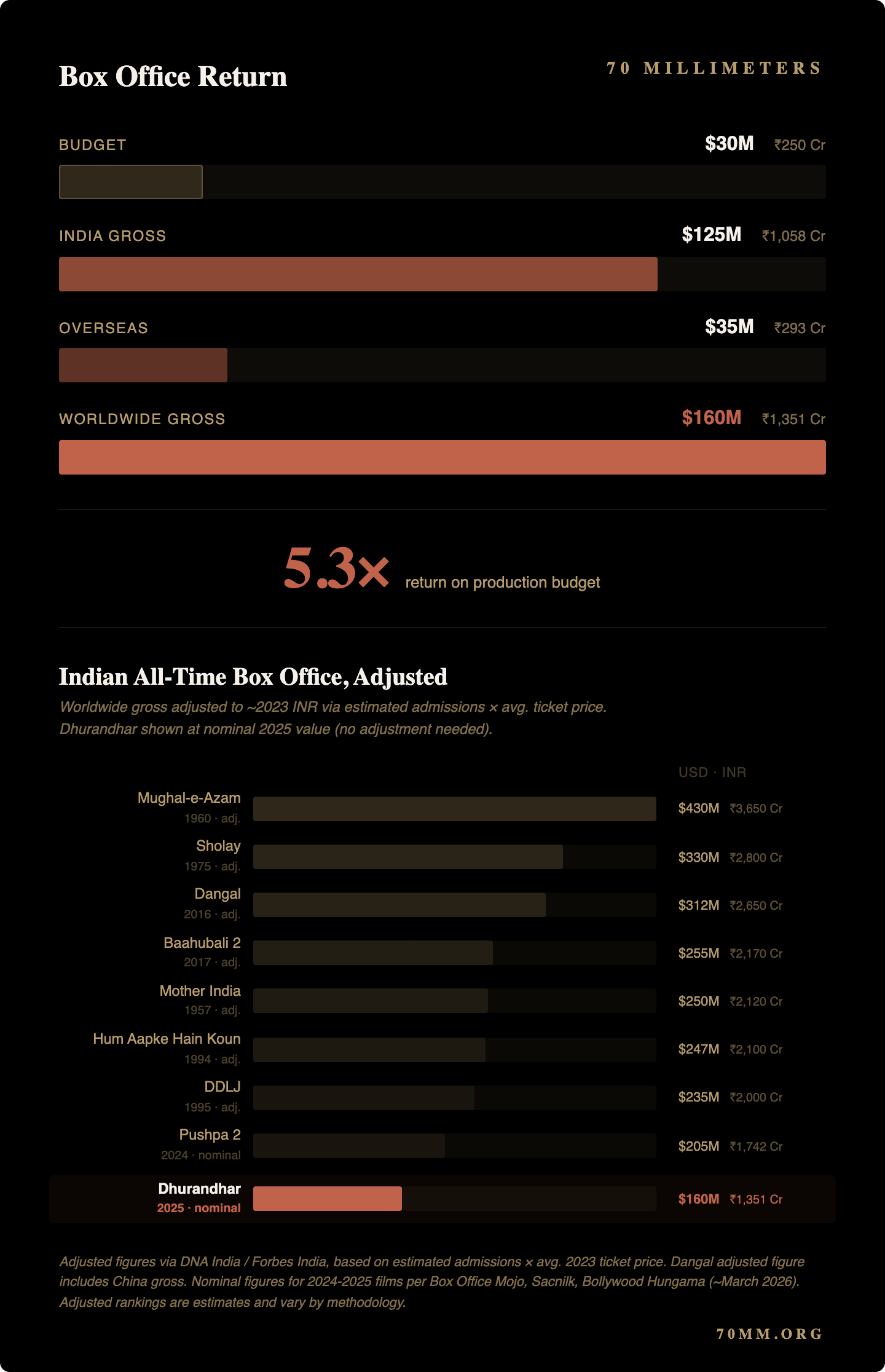
Dhurandhar represents something about the industry itself. Recent blockbuster films like Pathaan, where Indian and Pakistani spies team up in slick buddy-cop fashion, felt like fossils from an old agenda. Audience data suggests those films inflated and outright faked their box office numbers. Dhurandhar is popular because it doesn’t gaslight its audience for recognizing what the Indian diaspora has felt for years. It supports them, and gives them the movie they’ve been asking for.


Of course, the mafia’s grip on Bollywood didn’t loosen on its own. The Modi government has waged a visible, if messy, campaign to break the old networks. Lawrence Bishnoi, the gangster whose name now circulates through Bollywood like a whispered threat, functions as the blunt instrument of a new order: the old mafia dons who ran the industry from Dubai get replaced by a domestic enforcer who answers to different masters. Whether that’s justice or a changing of the guard depends on who you ask. But the result is the same. The stories the old gatekeepers suppressed got made. The audience - and market - is always right. The films that would have been buried a decade ago now gross ₹1,350 crore. Dhurandhar’s commercial triumph is a product of this shift. The audience showed up because someone finally let them have the movie they wanted.
Shashwat Sachdev on Dhurandhar has built a soundtrack that I think will be studied. It’s the ultimate fusion of modern and old to hit all quadrants of audiences. It has rock elements that feel almost American in places, then flips into nostalgic Hindi remixes, then into this fusion techno-modern Indian sound. The club scene and the song that follows it felt designed to penetrate the global mind. This wasn’t solely music made for people who already relate to the culture. They composed something that could reach everyone while staying authentic to their vibe.
“Naal Nachna” is when I really noticed how innovative the soundtrack was. The English samples make it immediately international, but it also weaves in old Hindi music remixed within the same song. “Ishq Jalakar - Karvaan” reworks a qawwali from Barsaat Ki Raat (1960), and initially got pulled from YouTube because its bass riff sounded like Queen’s “Another One Bites the Dust.” They re-released it with a different riff, but that global vibe remains in the background. “Run Down The City - Monica” remakes “Piya Tu Ab To Aja” from Caravan (1971). The Balochistan song, with the Arabic track “FA9LA” by Bahraini rapper Flipperachi, plays over Akshaye Khanna’s introduction and became one of the most iconic moments of the movie. Diljit Dosanjh and Hanumankind show up on “Ez-Ez.” Arijit Singh sings arguably the best song of the movie “Gehra Hua.” The album has 11 tracks across 38 minutes and the range is staggering. Music to drive through the night with the windows down.

My personal favorite was the piece that played when Rahman Dakait ascended to power as a politician:
The editing by Shivkumar V. Panicker deserves mention. The Akshaye Khanna dancing edit, where the FA9LA sequence cuts between his swaggering entrance and the shooting that follows, the guns arriving while your brain is still processing the dance, is brilliant filmmaking. Vikash Nowlakha’s cinematography is phenomenal and makes you feel immersed into the world. Lyari is dusty and alive. The wide shots of crowds cheering add a lot. The framing of Ranveer in the early chapters makes him look smaller, more easily swallowed by the world he’s infiltrating. As his power grows, the camera moves with him differently.
The combat in the final act is the film’s one weakness. The ending fight between Ranveer and Akshaye Khanna runs too long and too unrealistically. Wounds don’t seem to stay. Even the shooting: Rahman’s buddy gets shot and doesn’t flinch. The back-and-forth should leave someone incapacitated but never does. It’s contrived twice over: once to build to the moment where Ranveer sees 26/11 and summons his final strength, and again to get him across the Lyari border with Rahman still breathing. The punches that follow are satisfying. The emotional payoff lands. But the whole sequence could’ve been avoided with a better structural choice. Keep Rahman alive. Build a fight where you expect him to die and he doesn’t. The audience would’ve felt the gut-punch of his survival harder than any fistfight, and you’d preserve the chess logic the film spent three hours building. The boss battle should’ve been a chess problem, not a brawl, because the entire film up to that point was chess. To switch to checkers in the final twenty minutes is a misread. Ranveer carrying a thoroughly beaten Akshaye to the hospital afterward is hilarious, though. I’ll give them that.
The reference to the “unknown men” was cool. In esoteric history, the Nine Unknown Men were a secret society originating with Emperor Ashoka, India’s legendary ruler who converted to non-violence after the bloodiest conquest in ancient history. The idea that modern Indian intelligence carries this legacy, that sovereignty and intelligence are old traditions being reclaimed, gives the film a mythic beauty. A small touch that rewards those who know and believe.
If that’s propaganda, I don’t know what word we’re using for films that pretend none of this is real.
I haven’t seen Ne Zha 2 yet. But Dhurandhar feels like the same kind of moment for India that Ne Zha 2 represents for China. Or Parasite for South Korea. A domestic industry proving it can compete globally on craft, on scale, on ambition. Indian cinema has made great movies before. But most of those were art-house successes or dramas that played on cultural specificity. Dhurandhar is a ₹1,350 crore spy thriller that makes no concessions and has global relevance.
Project Hail Mary, the Ryan Gosling sci-fi film directed by Phil Lord and Christopher Miller, moved its entire Indian release from March 20 to March 26 to avoid Dhurandhar 2. A major Hollywood studio looked at the release calendar, saw an Indian sequel sitting there, and blinked. When asked about it, Lord and Miller joked: “How dare you have your own successful film industry.” Then Miller said he’d heard about the sequel and was happy for it. Both directors said a rising tide lifts all boats and called it good for the health of the global movie business. I agree. It’s a shame that the fraudulent academy, so thoroughly subverted from within, probably won’t recognize it as such. You can see a glimpse of that in how the critics called it propaganda:
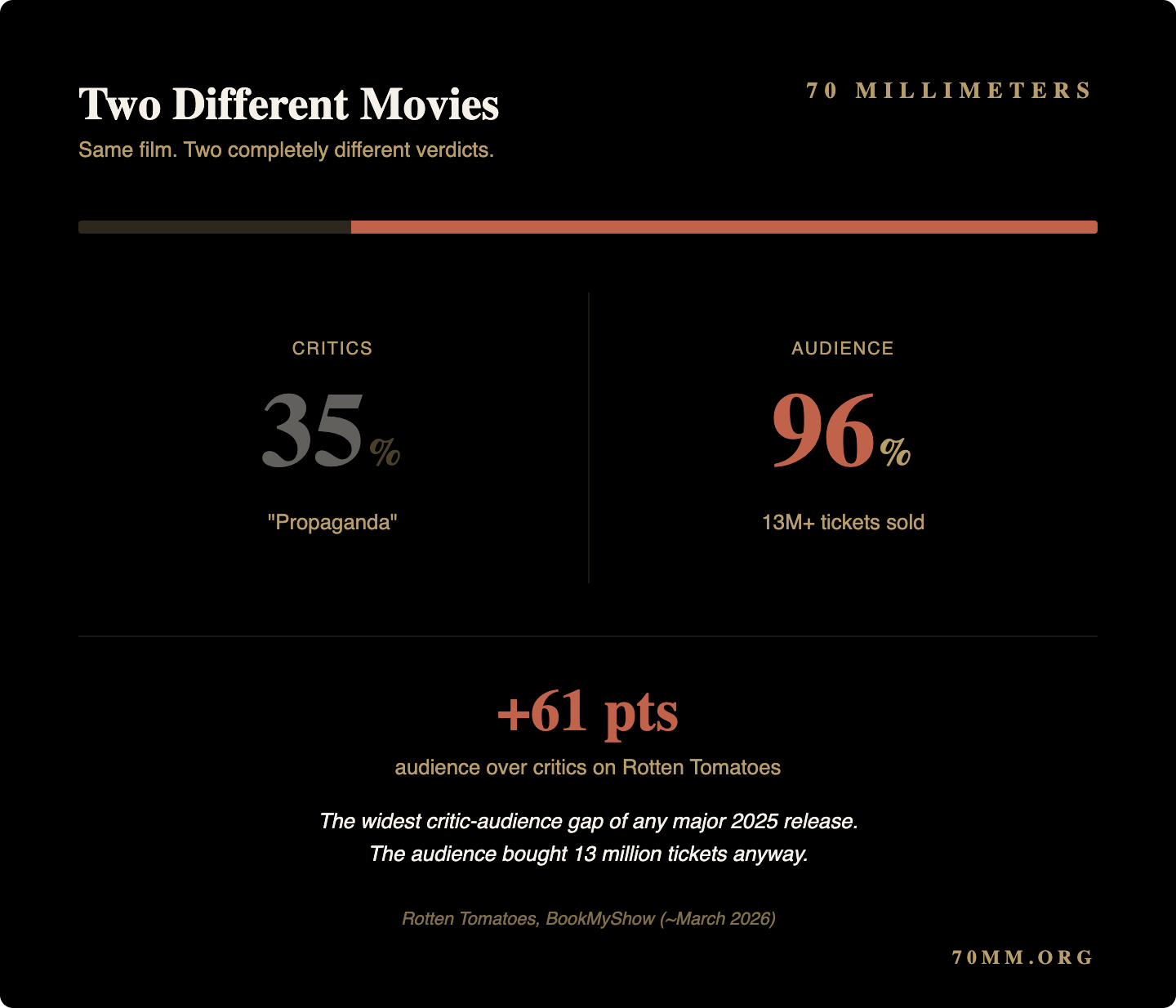
A 35% on Rotten Tomatoes from critics and a 96% from audiences. Rotten Tomatoes’ critics seem completely out of touch. I’ve rarely seen a split that bad. The critical establishment called it propaganda. The audience called it the movie they’d been waiting for.
I don’t see anything inaccurate or overly propagandized in the movie. I love questioning public narratives that solicit emotional reactions from large groups of people. In private I’m what some people call a conspiracy theorist. But I can say on my trip to Mumbai in 2024, I met people with friends who died in 26/11. It’s real. It’s sad. It’s insane. It’s not propaganda. These aren’t false flag attacks conducted by the Indian government. Maybe the implication that Pakistan is connected to every single terror attack in the history of the world is a stretch. But a country whose intelligence agency harbored Bin Laden, whose territory served as the staging ground for 26/11, whose military has run the state through coups for half its existence, does not get to claim the benefit of the doubt. Pakistan is a failed state. That’s not an ideological position. The people within the country would largely agree. And the film shows that. I’ve long been fascinated by the Balochs and the Pashtuns. Nations within a nation, with stories the world barely knows. The film does a great job telling their story. It lets you see them as people caught in a machine that grinds everyone, including its own. If that’s propaganda, I don’t know what word we’re using for films that pretend none of this is real.
Dhurandhar is the best spy thriller India has ever produced, with the best ensemble Bollywood has assembled in years, with a strong soundtrack, and with a level of geopolitical detail that assumes its viewers are rational adults. How well does it do it? Nearly perfectly. The ending fight almost costs it. Almost. But three and a half hours of this kind of filmmaking earns the benefit of the doubt on one miscalculated sequence. Bollywood has finally arrived on the global stage. From Dongri to Dubai to Dhurandhar.