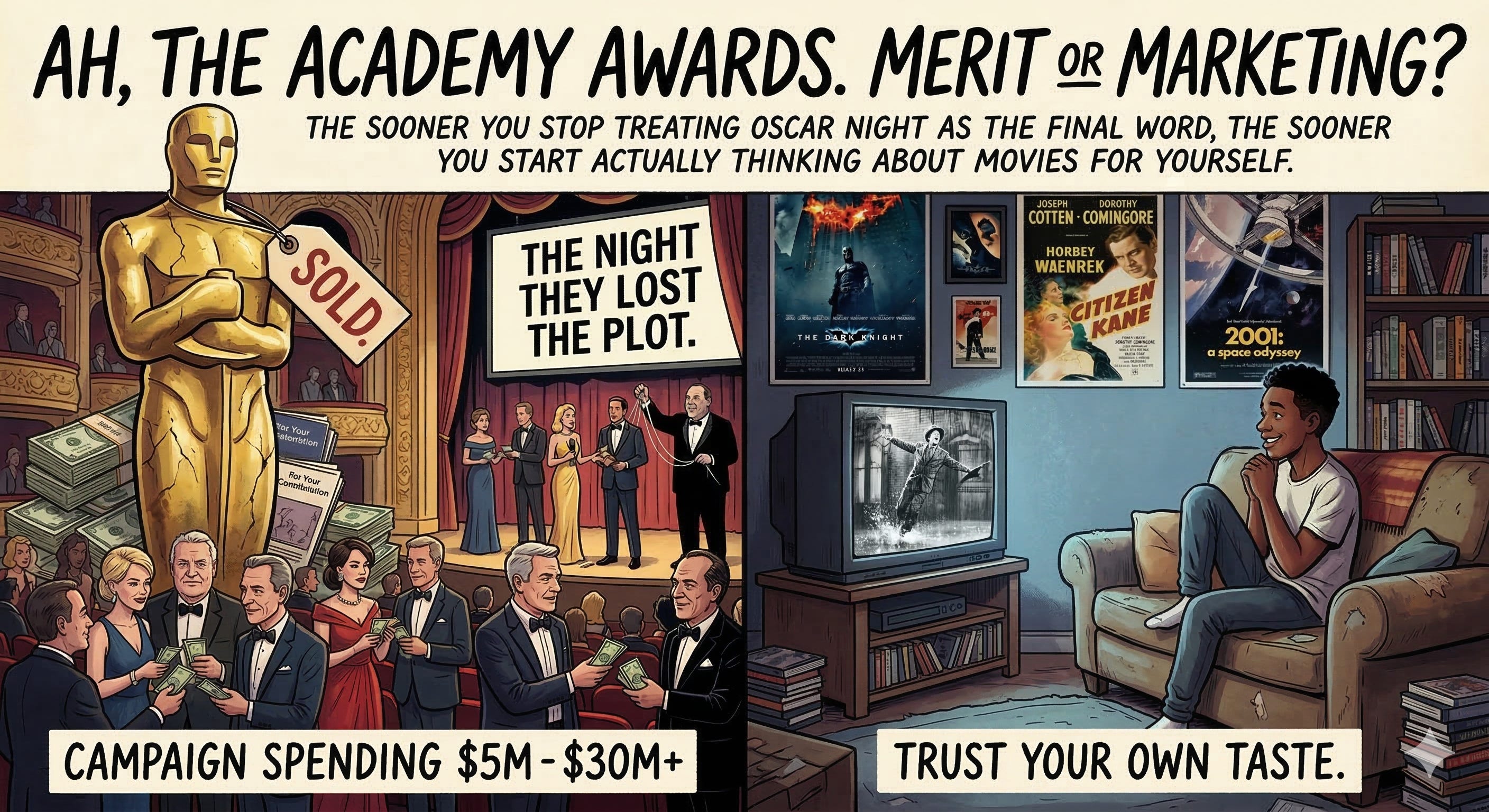

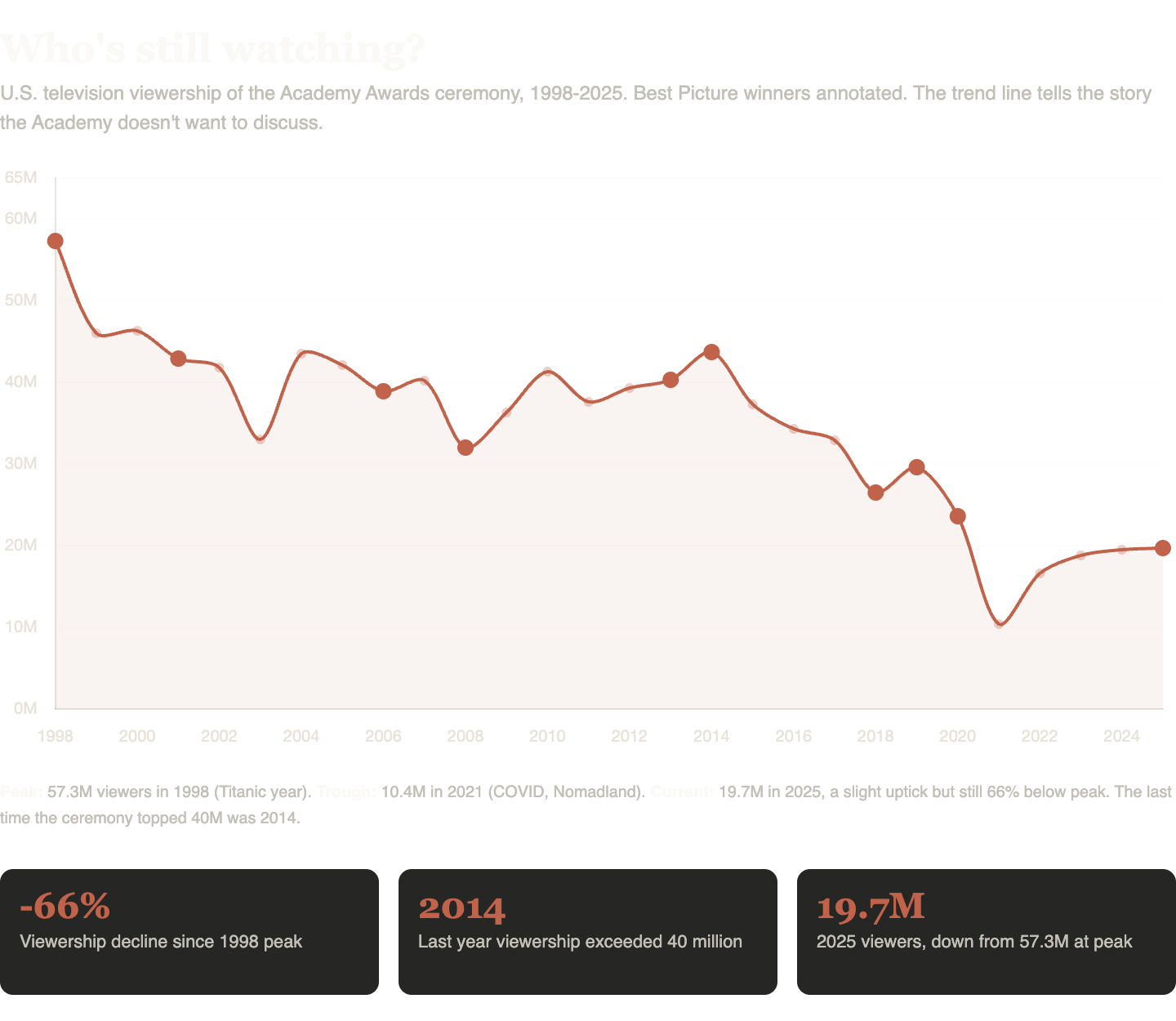
Ah, the Academy Awards. Every year, millions of people tune in to watch a room full of millionaires hand each other golden statues and pretend the process that got them there had anything to do with merit. It doesn’t. It hasn’t, for decades. The sooner you stop treating Oscar night as the final word on what matters in cinema, the sooner you start actually thinking about movies for yourself.
Anyone who relies on the Oscars as the backbone of their film discourse is telling on themselves. They’re telling you they don’t evaluate movies from first principles. That their tastes can be shaped by people they’ve never met. That they need an external authority to validate their taste, a stamp of approval before they can confidently call something great.
Recently, Deadline’s Pete Hammond published an email from an anonymous Oscar-nominated filmmaker who’d decided not to vote at all this year. He called Best Picture winners like Anora, CODA, and Everything Everywhere All At Once “irrelevant” compared to The Godfather, Lawrence of Arabia, and Patton, then said he’d rather spend Oscar night watching Singin’ in the Rain or North by Northwest or The Searchers, films he called “REAL best pictures which weren’t even nominated.”
“Hi, Pete, I enjoy your articles. I thought you might be interested to hear a take from an Academy member about this year’s rules. I haven’t seen even half of the nominated films, nor do I care to, because my time is far too valuable to spend watching movies I know I’d never vote for (much less be able to sit through). I found most of the films I did see to be mediocre, and nothing that I nominated made the final cut. Therefore, since I don’t want to lie, I decided I simply would not vote at all this year. Yes, I’d like to vote for K-Pop Demon Hunters, but not at the price of watching four other movies I know won’t be as good. But really, the Oscars have become pretty irrelevant. Anora? CODA? Everything Everywhere All At Once? vs The Godfather, Lawrence of Arabia, Patton? Which three movies will people still be watching five years from now? It’s all about the film, not the award. Rather than watch the Awards, I’ll probably watch Singin’ In The Rain or North By Northwest or The Searchers – REAL best pictures which weren’t even nominated.
Feel free to quote me, but please don’t use my name.”
This is an Academy member. A previous nominee in a major category, saying out loud what most people who love movies know: the Oscars have nothing to do with identifying the best films.
The Night They Lost the Plot
Most people started noticing in 2009. The Dark Knight earned over a billion dollars worldwide, received eight Academy Award nominations, won two of them, and was widely regarded as one of the finest films of the year by audiences, critics, and every guild that matters. The Producers Guild nominated it. The Directors Guild nominated it. The Writers Guild nominated it. The Screen Actors Guild nominated it. These are the people who actually make movies, and they all agreed: this was one of the best films of the year.
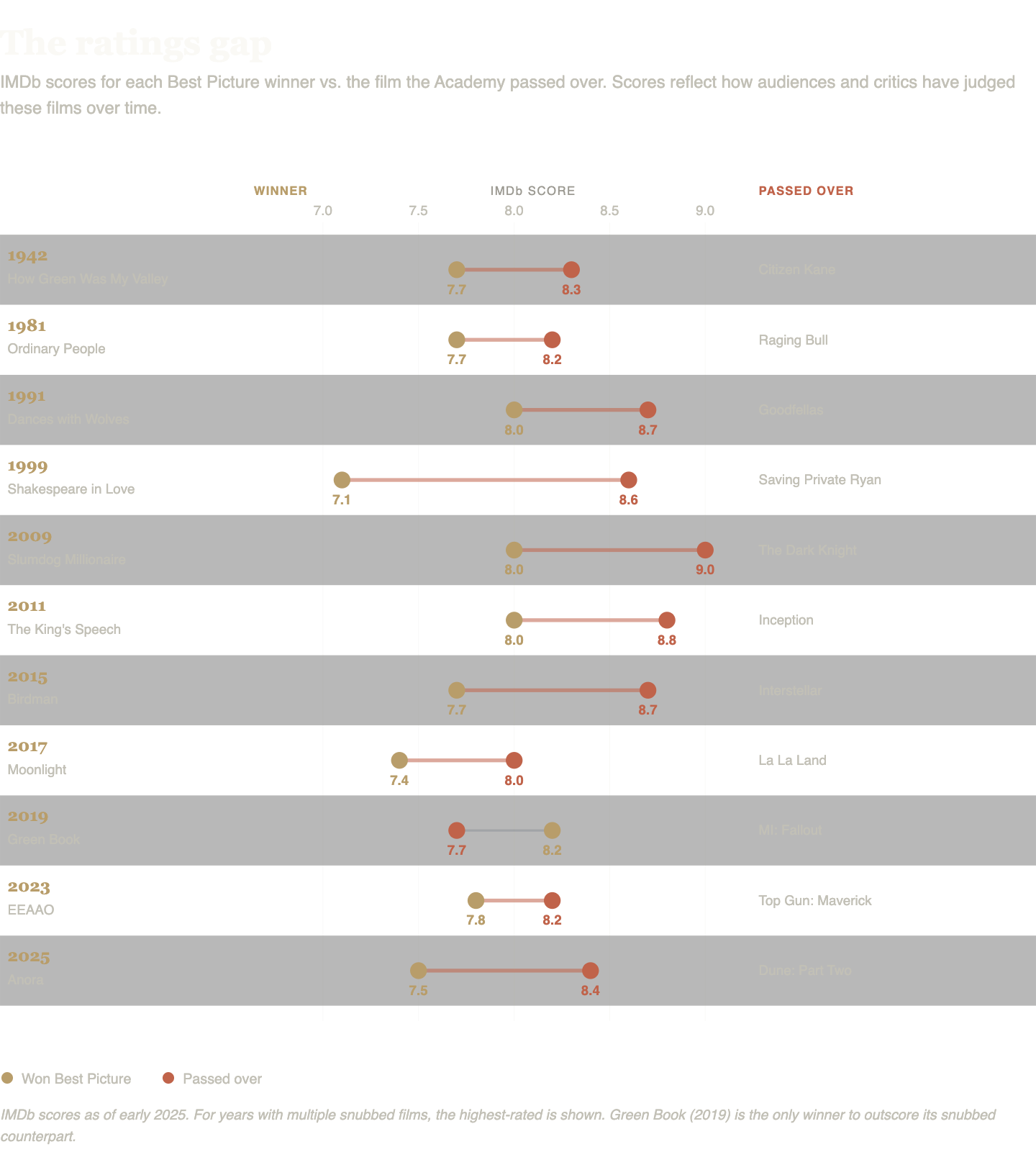
The Academy disagreed. The Dark Knight didn’t even get a Best Picture nomination. The five films that did? Slumdog Millionaire, The Curious Case of Benjamin Button, Frost/Nixon, Milk, and… The Reader? The Reader was a middling Holocaust drama with a 60-something percent on Rotten Tomatoes and the backing of Harvey Weinstein. It took the spot that should have been reserved for Nolan’s film, because Weinstein knew how to work the room and a comic book movie, no matter how extraordinary, offended the Academy’s sense of superiority. As ScreenRant reported, AMPAS president Sid Ganis later admitted that “the words Dark Knight did come up” when the Academy expanded to ten nominees the following year.
And the Dark Knight snub isn’t even the most egregious example. It’s just the one that broke the seal. Citizen Kane, widely considered the greatest American film ever made, lost Best Picture in 1942 to How Green Was My Valley. Alfred Hitchcock was nominated five times for Best Director and never won. Stanley Kubrick, who made 2001: A Space Odyssey, A Clockwork Orange, The Shining, and Full Metal Jacket, never won a directing Oscar. His only competitive win was for visual effects. Goodfellas lost Best Picture to Dances With Wolves. Singin’ in the Rain wasn’t even nominated. These are the consensus greatest films in the history of the medium, and the Academy got them wrong.

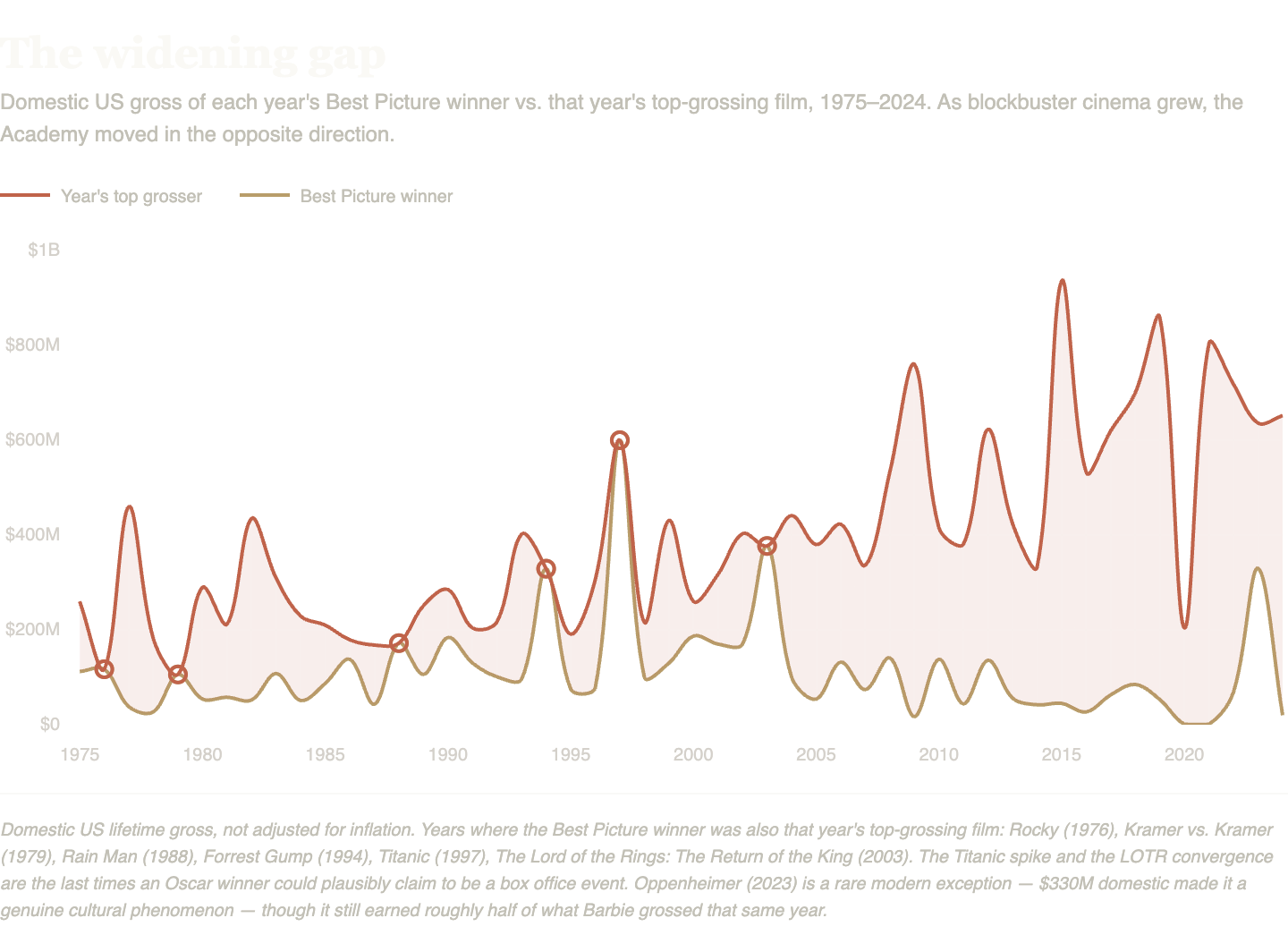
Yes, the Academy has gotten it right before. Schindler’s List. The Godfather. No Country for Old Men. Most recently, Oppenheimer. There are years where the Best Picture winner is genuinely, unarguably, the best film of the year. Nobody is disputing those.
But that’s almost worse. Because it proves the Academy is capable of good judgment when it chooses to exercise it. They can recognize greatness when it arrives in the right packaging, when it comes from the right filmmaker, when it carries the right cultural signals. The years they get it right are what keep the institution’s lingering scraps of credibility alive. Those wins are the alibi. “We gave it to Schindler’s List, so trust us when we give it to Anora.” The occasional correct answer makes all the wrong ones harder to challenge. If they got it wrong every single year, nobody would take them seriously at all. The fact that they nail it just often enough is exactly what allows the rest of the fraud to continue.
Sexual Predators Designed the System
Nobody in Hollywood wants to say this out loud, but the modern Oscar campaign was designed by predators.
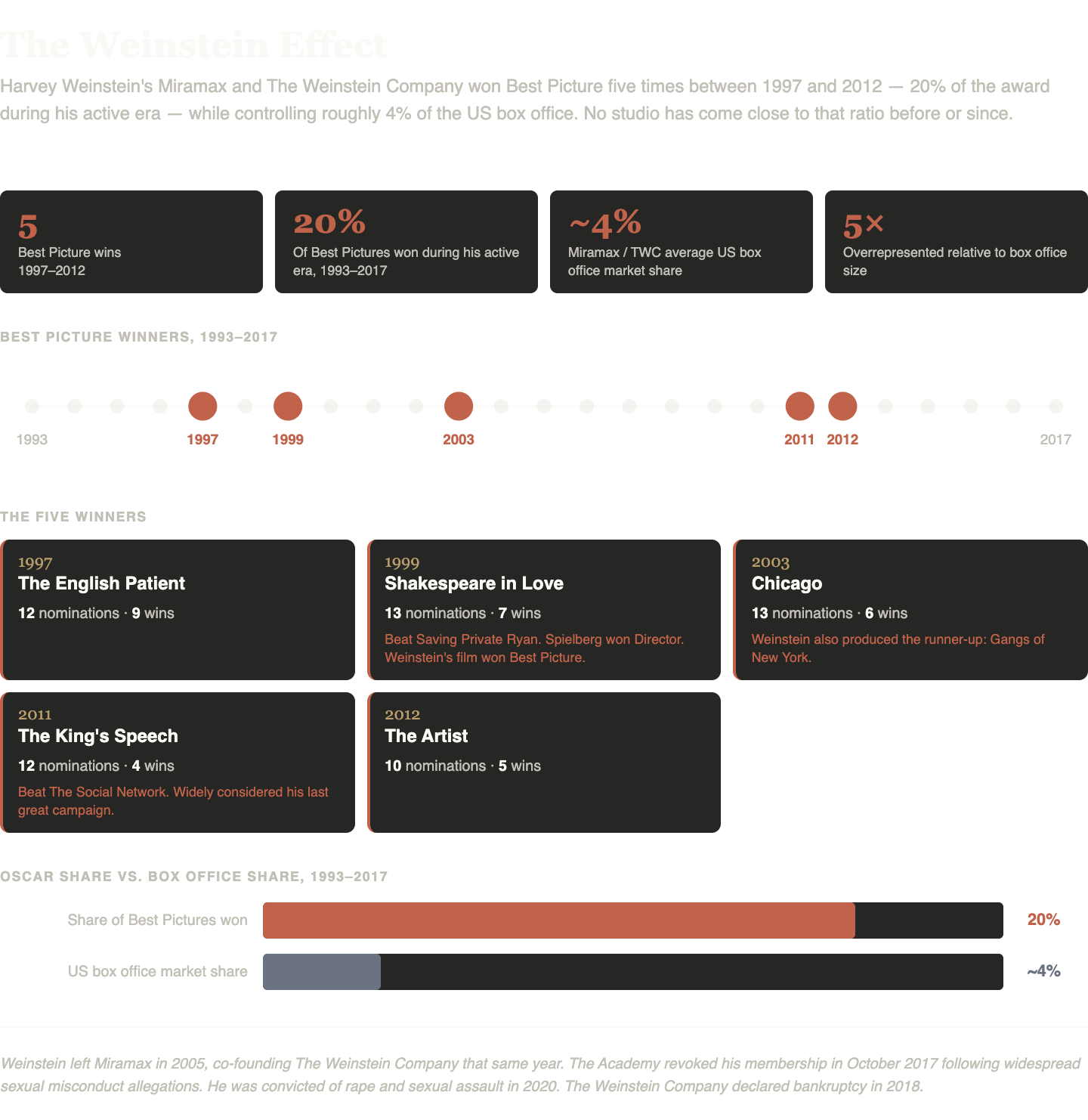
Harvey Weinstein built the playbook. His 1999 campaign for Shakespeare in Love upset Steven Spielberg’s Saving Private Ryan for Best Picture, and the tactics he used became the industry standard. Lavish parties. Whisper campaigns against rivals. Relentless schmoozing of the roughly 10,000 Academy voters. As LAist documented in their history of Oscar campaigning, every aggressive strategy the Academy now technically prohibits was invented at Weinstein’s Miramax, and the consultants who ran those campaigns “have since kind of fanned out across town and now run the awards campaigns for all the different places that are in the game.” The architecture of the modern Oscar race was built by a sexually deviant convinced creep with a $1.68 billion verdict against him.
When Mo’Nique won her SAG and Golden Globe for Precious and was the clear Oscar frontrunner, she was told to go above and beyond promoting the film.
“The performance is on the screen,” she said. “Y’all are making this now personal. I don’t need to have a personal relationship with any of these people, nor do they need to have one with me. They’re judging the performance.”
She refused the full schmooze circuit. She says she was blackballed for it. She still won the Oscar, but her career stalled for years afterward. That’s the system. Play the game or get punished.
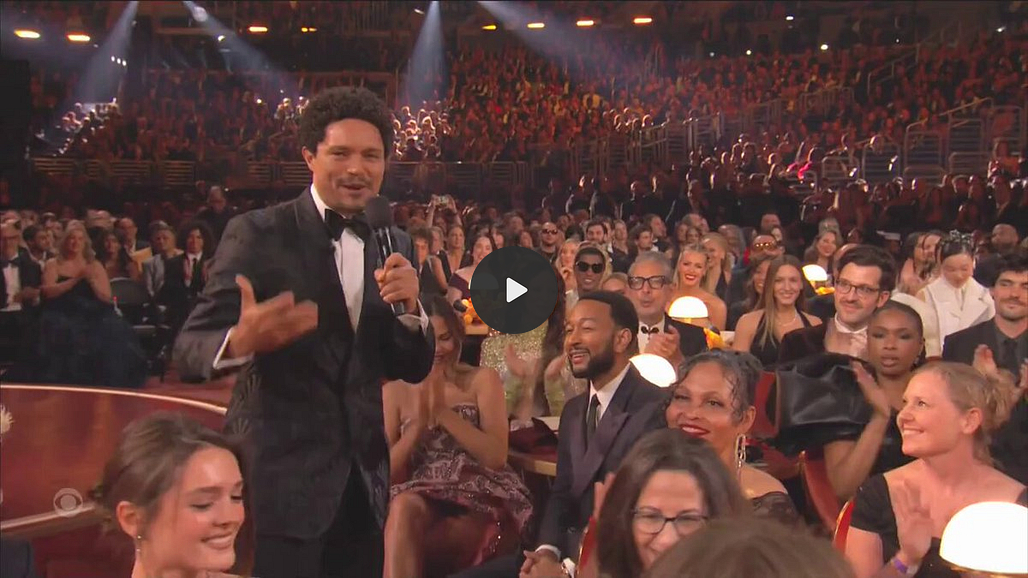
Ricky Gervais stood on the Golden Globes stage in 2020 and brought a rare dose of common sense to the ceremony. He joked about Jeffrey Epstein and then told the groaning crowd: “Shut up. I know he’s your friend, but I don’t care.” He compared working for Weinstein to starring in Bird Box, “a movie where people survive by acting like they don’t see a thing.” He told every winner not to use the stage for political speeches because “you’re in no position to lecture the public about anything. You know nothing about the real world.” Two hundred million people watched that monologue. It was the most honest eight minutes in the history of awards television, and the room hated every second of it. The best jokes contain half-truths. This was an iconic speech in a room full of people who had dined with Weinstein and Epstein and Diddy, who knew what was happening behind closed doors for decades, who smiled to cameras and said nothing, and who then had the nerve to stand on a stage and lecture the public about morality.
These are the people who decide what the best movie is. These are the experts. The ones who make a show of reminding you they hate ICE and that there’s nobody illegal on stolen land, who perform outrage about whatever cause is trending that week, while living in mansions behind gates in neighborhoods they got after they went through whatever perverted initiation ceremony the industry requires.
“If you do win an award tonight, don’t use it as a platform to make a political speech. You’re in no position to lecture the public about anything. You know nothing about the real world. Most of you spent less time in school than Greta Thunberg.” — Ricky Gervais, 2020 Golden Globes
The topics they moralize on are causes they discovered through their publicists five minutes before the telecast. Disgusting, ignorant people whose actual track record of looking the other way on abuse, trafficking, and exploitation spans decades. Nobody needs an ethics lecture from that crowd. Audiences see through it now, which is part of why the industry is struggling to bring people to theaters.

What Best Picture Actually Rewards
So what does this industry, with all its moral grandstanding, choose to celebrate?
Anora won Best Picture at the 2025 ceremony. Five Oscars total. A movie about a sex worker. Made for $6 million. Grossed $40 million worldwide, one of the lowest-grossing Best Picture winners in history. Sean Baker dedicated his Palme d’Or win to “sex workers past, present, and future.” The Academy looked at every film released in 2024 and decided that this was the pinnacle. A movie that almost felt purposely steered to the top to provoke, to dare families and regular moviegoers to object so they could be told they don’t understand art. It’s a sexualized, transgressive film presented as the year’s crowning achievement, and if you think that selection exists in a vacuum, disconnected from the broader cultural agenda that rewards exactly this kind of provocation, I have a golden statue to sell you.
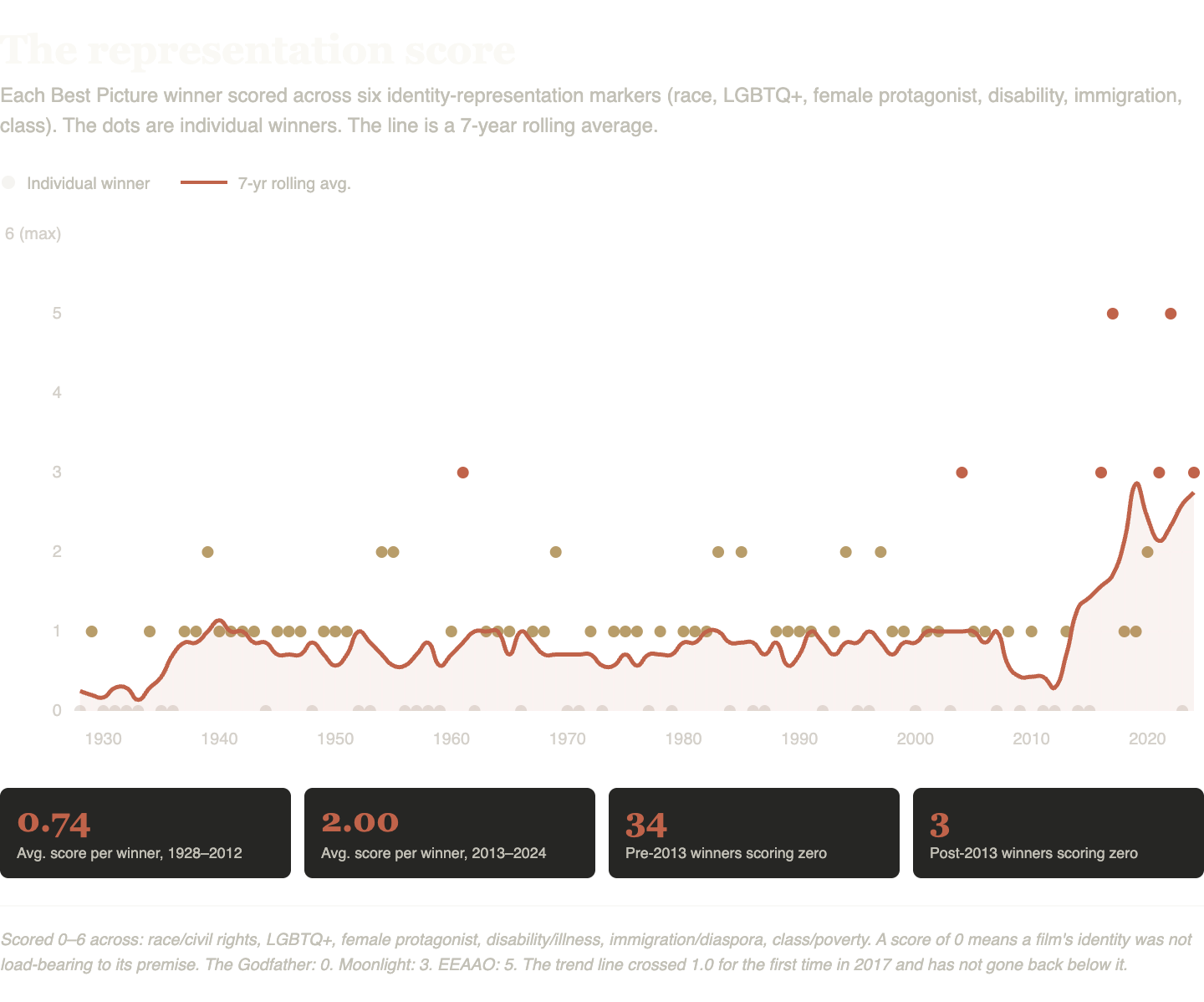
I remember when Moonlight won Best Picture. I went to see it because the reviews were relentless. Every critic in America falling over themselves. I sat through the whole thing waiting for the movie everyone described to start. It never did. Instead, I got one of the most awkwardly sexualized, creepy, uncomfortable theatrical experiences of my life. There’s no hero. There’s no arc that earns its resolution. There’s no transformation that the audience gets to ride along with. The film is structured as a triptych, three chapters in a man’s life, and in each one the character is essentially passive, things happening to him while the camera asks you to feel sympathy for his queerness. The whole movie operates like a social essay pretending to be cinema, a statement piece where the statement is the point and the filmmaking serves it rather than the other way around. There’s nothing to grab onto as a viewer. No momentum. No stakes beyond “empathize with the homosexual experience or admit you’re a bigot.” If that movie changed your life, great. Art is personal. But the idea that it was the best picture produced by the American film industry that year requires a definition of “best” that most people who buy movie tickets would not recognize. It won because voting for it signaled the right values. In a sane world, Moonlight is a small, respected indie film that finds its audience. In a world obsessed with highlighting DEI and performing suicidal empathy, it wins the biggest prize in cinema.
There’s a pattern here. The Academy consistently rewards films that push sexualized, transgressive, or identity-focused content to the top of the pile. Films that seem designed to make normal audiences, parents, families, feel like outsiders in their own culture. And if you object, you’re the one with the problem. You’re the one who doesn’t get it. The Academy has been optimized to celebrate a very specific worldview and to punish anyone who questions it by making them feel unsophisticated.
The Price of "Victory”
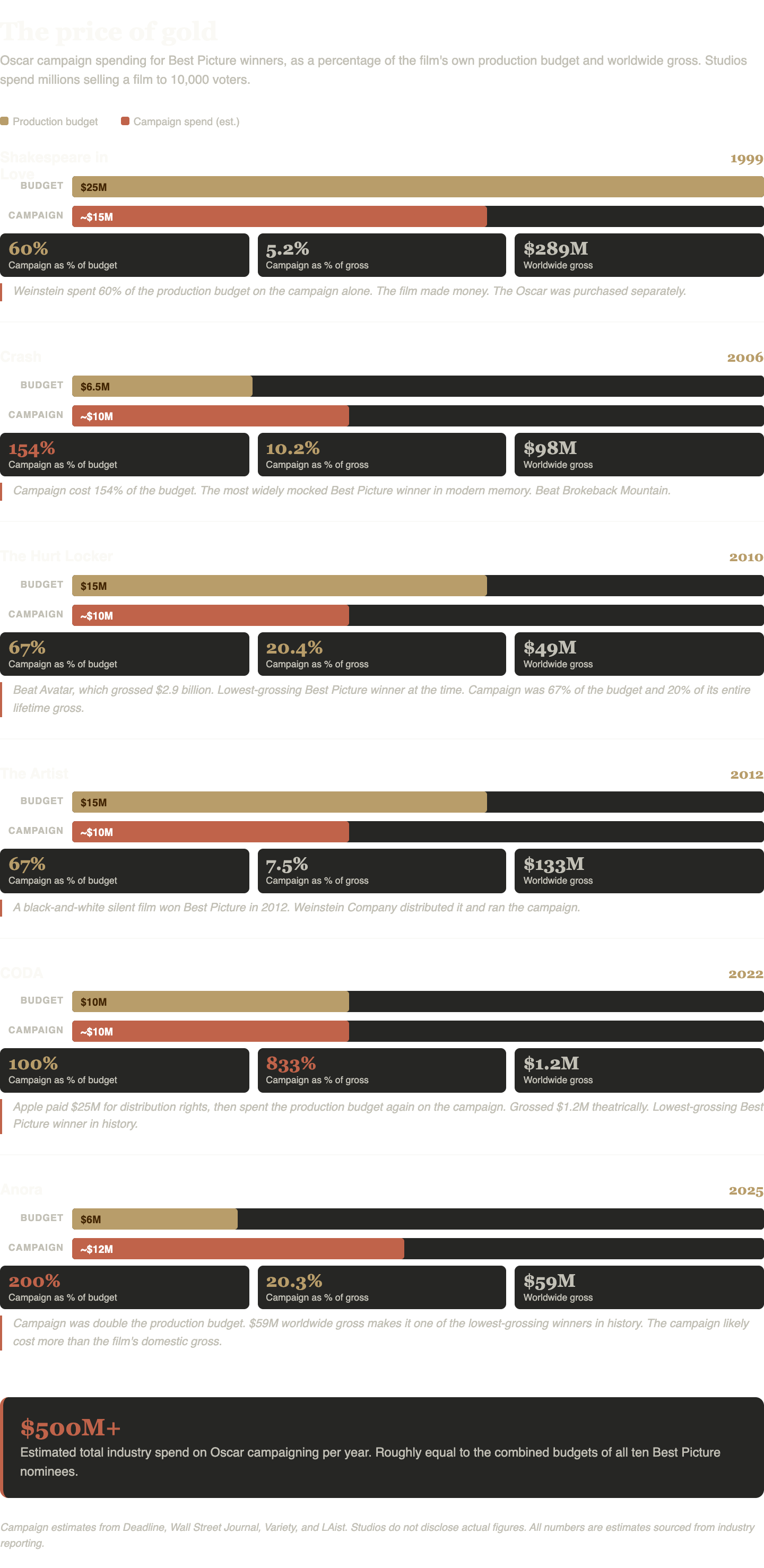
The crazy part is how much the Oscar campaigns cost. William Friedkin, who won Best Director for The French Connection and later produced the Oscar ceremony itself, described the Academy Awards as “the greatest promotion scheme that any industry ever devised for itself.” George C. Scott called the ceremony “a two-hour meat parade.” Dustin Hoffman called them “obscene, dirty, no better than a beauty contest.” These are people who won and still found the process repulsive.
Studios spend between $5 million and $30 million per film campaigning for Oscar nominations and wins. Netflix reportedly spent $25 million on Roma’s campaign alone, sending Academy voters custom pillows and 200-page coffee table books. The total industry spend on Oscar campaigning is estimated at over half a billion dollars per year. That’s roughly the combined production budgets of all ten Best Picture nominees. For context, Warner Bros. spent around $20 million campaigning for Argo, and another $20 million for Gravity. Netflix’s campaign budget for a single season has been reported as high as $100 million.
“The (Academy Award) ceremonies are a two-hour meat parade, a public display with contrived suspense for economic reasons.” — George C. Scott, who refused his Best Actor award for Patton
Studios hire dedicated Oscar consultants whose entire job is to wine and dine voters. They host lavish Q&A screenings, curated luncheons, “For Your Consideration” ad blitzes on every billboard in Hollywood. The Academy has rules against directly asking for votes, so the operation is structured as a euphemism: we’re just hosting a discussion about the film, not asking you to vote for it. And then there’s a catered lunch and a gift bag worth $200,000 and the unspoken understanding that reciprocity is the currency of the industry.
“If there’s some big dark secret about the academy that the public can’t appreciate, it’s that these are people with day jobs so, like you, they have limited time to see movies. They will vote without seeing movies. That’s where campaigns make a difference.” — An Academy voter, speaking to ABC News
And the new rules don’t fix it. The Academy introduced a requirement in 2025 that voters must attest they’ve watched all nominees in a category before voting. It’s enforced on the honor system. The anonymous filmmaker who emailed Deadline this week proved exactly how well that’s working: he hasn’t seen half the films and isn’t going to bother. Deadline’s own reporting confirms that out of 317 eligible films, only 30 titles received nominations across the major categories, and just 15 of those received more than one nomination. The same few films dominate every category. The movies with the biggest campaigns and consensus that they deserve to win take up all the oxygen, and everything else, no matter how good, never gets seen by the people voting.
So when someone tells you a film “won Best Picture,” what they’re really telling you is that a film’s distributor spent millions of dollars over six months convincing a small group of voters to check a box.
The Gatekeepers
The Academy doesn’t just anoint “winners.” It actively influences what’s allowed to be considered great and sophisticated.
Christopher Nolan made The Dark Knight, Inception, Interstellar, and Dunkirk before the Academy gave him a single Best Director nomination. Think about that filmography. The ambition, the technical innovation, the cultural impact. Nolan pioneered the use of IMAX cameras in narrative filmmaking. He built practical sets that other directors wouldn’t attempt. He made original, complex, adult blockbusters that grossed hundreds of millions while respecting the audience’s intelligence. The Academy’s response for fifteen years was “not good enough.”
Then Oppenheimer came along. A serious historical drama. Three hours. Black and white sequences. Based on a Pulitzer Prize-winning biography. Finally, the Academy decided Nolan was worth recognizing, because he’d finally made the type of movie the Academy was comfortable celebrating. He’d played their game, and they rewarded him for it. As Steven Spielberg himself acknowledged, The Dark Knight “would have definitely garnered a Best Picture nomination today.” Fifteen years too late. The think pieces about Nolan’s “relationship with the Oscars” all feel like part of a ritualized humiliation process, the whole industry watching a generational filmmaker wait for the Academy to grant permission for his work to be taken seriously.
Tom Cruise is the same story. Four Oscar nominations across his career. Three for acting, one for producing Top Gun: Maverick. Zero competitive wins. The man has spent forty years as one of the most committed, physically daring actors in the history of the medium. He jumps out of planes. He hangs off the side of buildings. He broke his ankle on camera and kept shooting. At 63, he’s doing things that stunt performers half his age won’t attempt. The Academy’s response? An honorary Oscar at the Governors Awards in November 2025, a separate ceremony that doesn’t even air on television. A consolation prize at a private dinner.
And the timing is perfect in the worst way. The Academy announced a new stunt design category in April 2025, set to debut at the 100th ceremony in 2028 for films released in 2027. After decades of stunt performers risking their lives without recognition, they finally created the award. Except it arrives after the peak of the most extraordinary stunt career in film history. They gave Cruise an honorary statue and created the real award too late for it to matter to the person who made the case for it. I believe that’s consistent with the Academy’s petty behavior: institutional contempt masquerading as recognition. Peter O’Toole got the same treatment: eight acting nominations, zero wins, and an honorary Oscar in 2003 after a career that included Lawrence of Arabia. “Always a bridesmaid, never a bride, my foot,” he said on stage. The Academy loves giving you the real thing after it no longer matters.
There’s a snobbish belief within the Academy and the critical circles that orbit it that entertaining movies don’t expand the art of filmmaking. That mass appeal is suspicious. That if millions of people love something, it probably isn’t serious enough to be great. So they punish filmmakers like Nolan and Cruise for the crime of being popular, and they reward films that most of the ticket-buying public will never see and wouldn’t enjoy if they did.
“I lost faith in the Oscars the first year I was a movie critic — the year that Bonnie and Clyde didn’t win.” — Roger Ebert
The best action movies of all time don’t win Best Picture. Best Picture, in many years, is reserved for niche, arthouse films that appeal to the weird theater kid sensibility, the quirky, self-serious intensity that mistakes its own niche taste for universal sophistication. If you knew theater kids growing up, you know exactly the energy I’m describing. That energy runs the Academy.
The foreign film category is its own kind of farce. A film like Dhurandhar, India’s highest-grossing Hindi film of 2025, a spy thriller that audiences across India and the diaspora showed up for in record numbers, grossing over ₹1,000 crore worldwide, has zero chance at the Academy. Arguably the best Indian movie ever made! It’s hard to believe this can be separated from its story, which runs against certain liberal narratives that would make its celebration uncomfortable for the voting body. A film that calls out Islamic terrorism becomes “Islamophobic” in the Academy’s framework. The Academy’s idea of “international” cinema is carefully curated to include films that reinforce a particular worldview and to exclude anything that challenges it. The foreign category probably doesn’t even consider most foreign language films: it only considers the ones that pass the vibe check of a very specific political sensibility.
The Independent Mind
Anyone who relies on the Oscars as the backbone of their film discourse is outing themselves. They’re telling you they don’t evaluate movies from first principles. They need an external authority to validate their taste, a stamp of approval before they can confidently call something great. They wait for the nominations to come out before deciding what’s important. They let the event shape their tastes instead of ignoring it.
The entire award ceremony is a scam. A marketing event designed by predators, sustained by lobbying, and weaponized to enforce a cultural agenda that has nothing to do with identifying the best films and everything to do with telling you what you’re allowed to admire. Timothee Chalamet’s supposed decline in Academy Award chances after accurately calling out ballet kinda shows you where their priorities lie.


This is groupthink in a tuxedo. The Academy tells you the consensus. The critics reinforce it. The discourse amplifies it. And anyone who disagrees is either a populist who doesn’t understand cinema or a contrarian trying to get attention. The possibility that the system itself is broken, that the people making these decisions are incentivized by politics and money and social positioning rather than genuine love of the craft, is never seriously entertained. Most within Hollywood become, by default, participants in the corporate Hollywood machine’s lack of innovation and the overall nepotistic, closed-door nature of the Academy.
Here’s who I trust: the filmmaker who made something ambitious and doesn’t care whether it gets nominated. The audience member who can tell you exactly why a movie worked or didn’t, who felt it in their body, who walked out of the theater vibrating and can explain why without referencing a single award. The person who has the conviction to say The Dark Knight is a great film without adding “for a superhero movie,” and who doesn’t need the Academy’s permission to believe it.
The Oscars are a political sham. True cinephiles don’t pay attention. The best films ever made don’t need a trophy to prove it, and the trophy doesn’t prove anything except that someone spent enough money, threw enough parties, and said the right things to the right people in the right rooms.
The next time someone asks if you watched the Oscars, try this: tell them you spent the evening watching a great movie instead. You chose it yourself. No one told you it was the best. You just knew.