


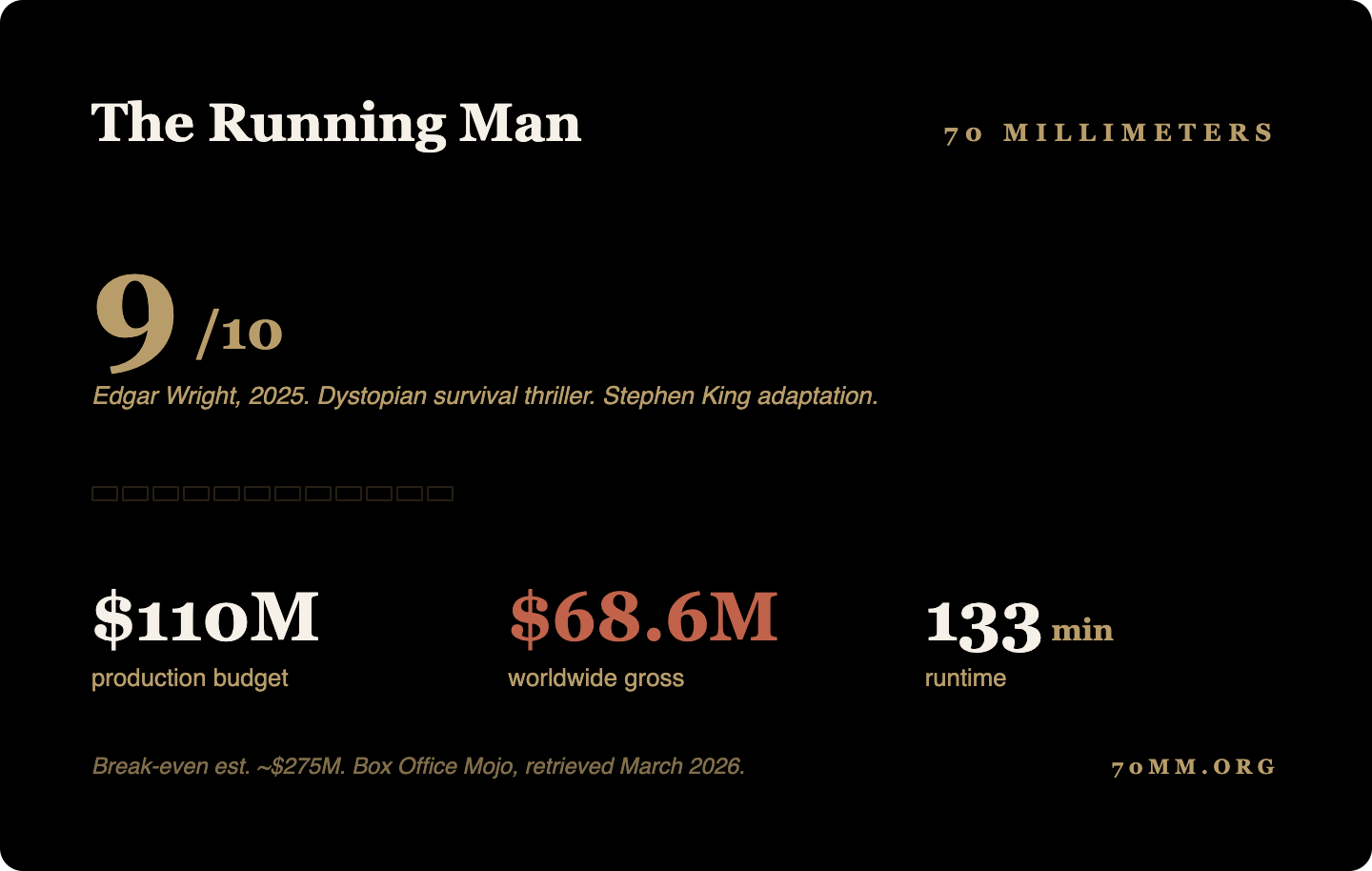
9/10
Edgar Wright's adaptation of Stephen King's 1982 novel is a paranoid thriller where Glen Powell plays a man forced into a televised death game. The worldbuilding is the star here: the UX of the in-world technology, the broadcast graphics, the game mechanics make for a stunning watch. It's a dark comedy about the attention economy that feels uncomfortably close to the one we already live in. If you can buy the premise, you won't look away.
Director: Edgar Wright
Writers: Edgar Wright & Michael Bacall
Cast: Glen Powell, Josh Brolin, Colman Domingo, Jayme Lawson, Lee Pace, Michael Cera, William H. Macy, Sean Hayes, Emilia Jones
Cinematographer: Bill Pope
Composer: Steven Price
Studio: Paramount Pictures
Genres: Dystopian, Survival Thriller, Dark Comedy, Sci-Fi, Action, Conspiracy
There's a moment in The Running Man where Glen Powell has to deposit a recording into one of those safe boxes, and you realize you've been holding your breath. Nothing exploded. But the world Edgar Wright built has convinced you, bone-deep, that this small errand could get a man killed.
This is Wright's adaptation of Stephen King's 1982 novel, his dream project since at least 2017. I haven’t seen Schwarzenegger’s original 1987 version. Wright and co-writer Michael Bacall drew from King's original premise: a man hunted across a real city, tracked by a real audience, with the entire country watching and participating. It didn’t get the same love as F1, Sinners, or other movies of 2025. But I found this to be one of the most enjoyable movies of the year, and unique among action movies in recent history.
Most studio thrillers never reach the obsessive detail poured into how the game operates. The game runs for 30 days. You survive, you win a billion dollars. Nobody’s ever survived. Powell plays Ben Richards, a blacklisted laborer who enters to pay for his sick daughter’s medical care. Josh Brolin’s Dan Killian, the show’s producer, convinces him to sign up.
The show is beautiful. The UX of the in-world technology. The fonts on the broadcast screens. The way television coverage cuts between camera angles, graphics, and audience reaction shots. The tracking system that monitors Powell's location at all times. The mandatory daily recordings he has to file. The safe box deposits. The rules about forfeiting. You could write a rulebook for this thing. That specificity is what makes it so interesting. I sat forward through most of this movie. The editing was phenomenal. My hands were tense for stretches I didn't notice until they ended.
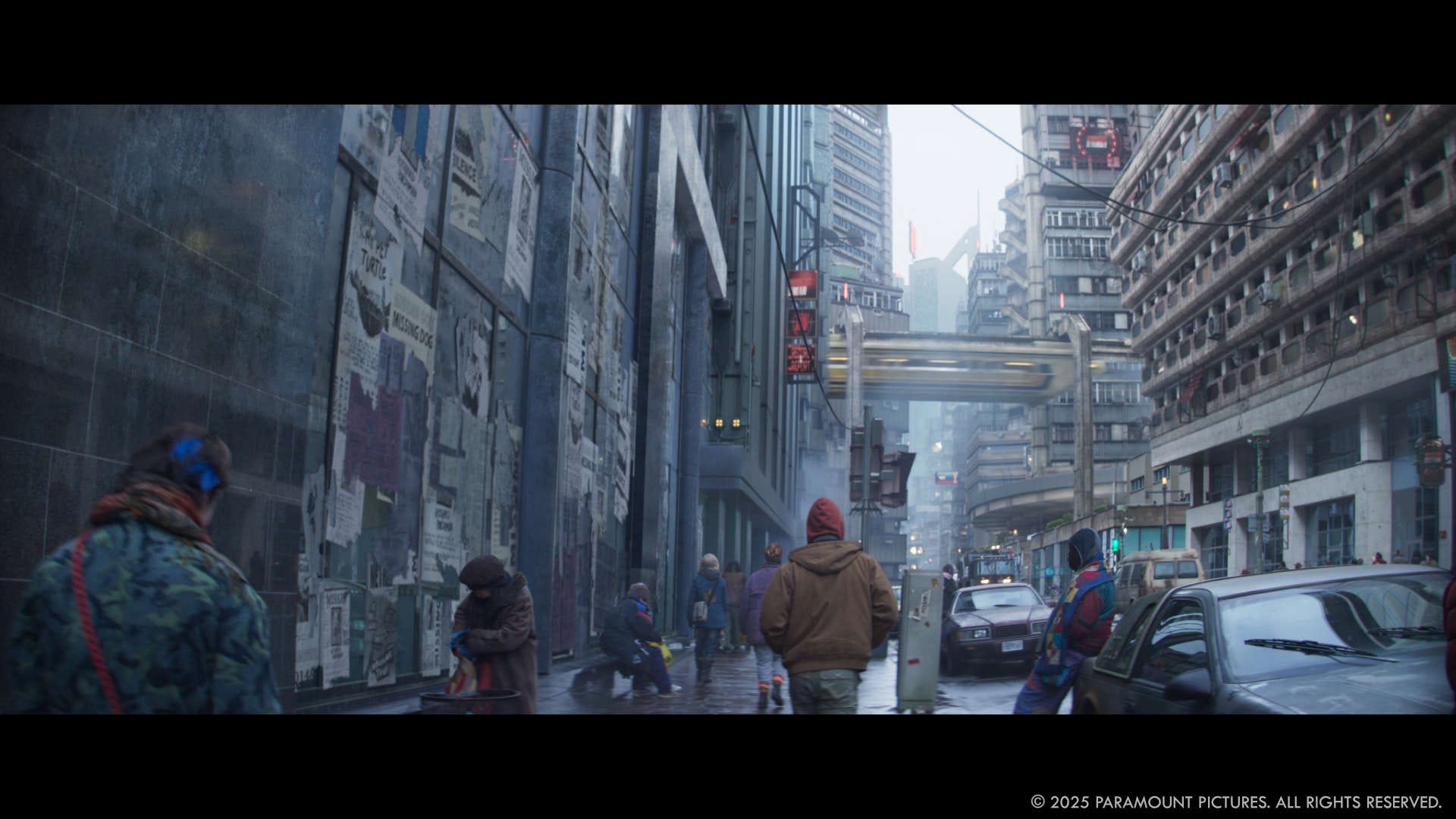
Wright shot this in London, Glasgow, and Bulgaria, and the film keeps things brutal. Cityscapes, highways, the contained corridors of civilization. No tropical hideouts. The claustrophobia is the point. Richards can't outrun the system because the system is everywhere. Chung-hoon Chung, Wright’s cinematographer who previously shot Last Night in Soho for him, finds an interesting visual look for the world. Think of our reality with the saturation dialed back slightly and a layer of grime across everything, and slightly more neons. The desaturated neons make it more immersive than the full cyberpunk palette. This is closer to home. Enough color to feel lived-in, enough dimness to feel wrong. Dystopia that feels like it’s not too far removed from our world.
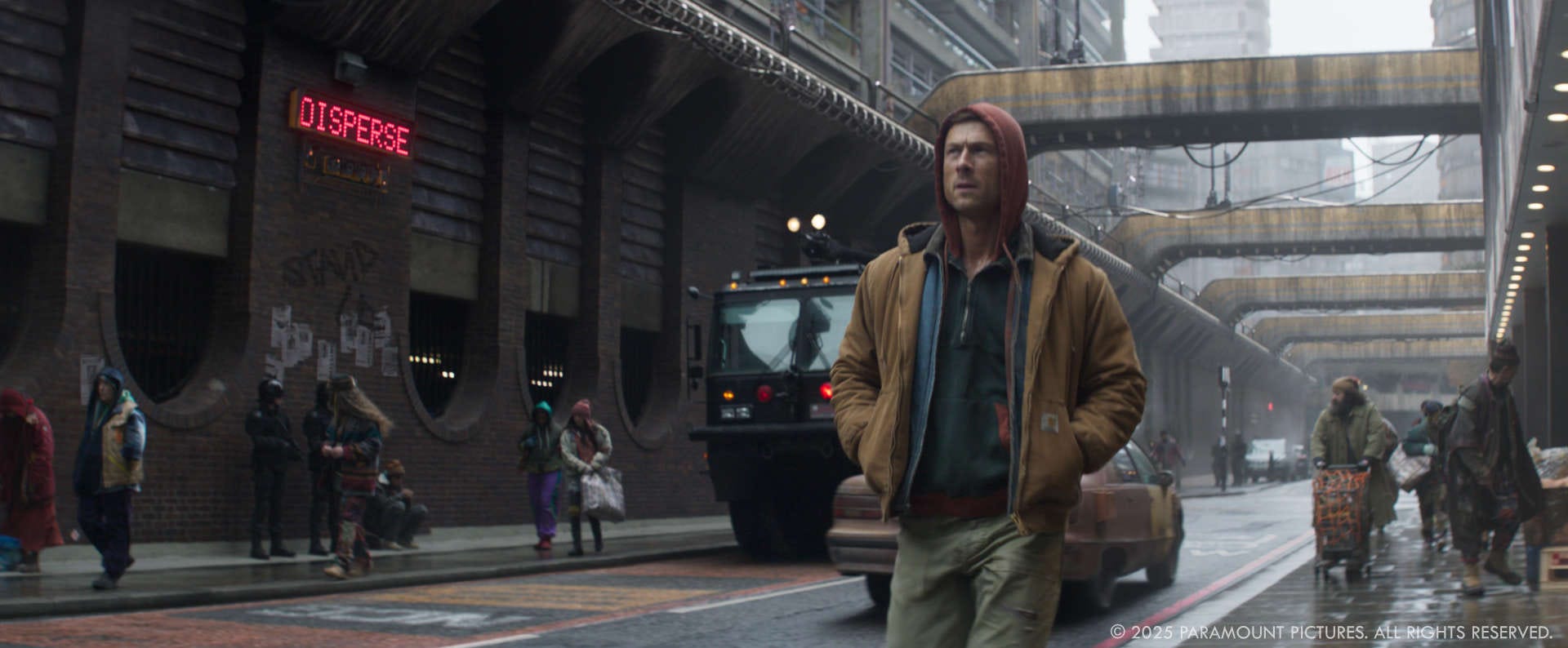
Powell is well cast. You believe he’s cornered, angry, and running out of options even when he’s winning. Wright is smart enough not to make him superhuman. There's a ceiling on what this man can survive, because the film respects you as a viewer. Powell does a great job portraying rage and arrogance. This is the most anyone has demanded of Powell physically and emotionally in a single film, and he carries it. The desperation of a father watching the clock while the country watches him.
“He’s capable, but he’s still not John Wick. He’s not a superhero. He’s a dad, and he’s kind of flying by the seat of his pants.” — Edgar Wright, Den of Geek
The cast around Powell does a good job. Brolin is great, a caricature corporate villain who has confused ratings with righteousness. He genuinely believes what he's doing is entertainment, maybe even public service. He thinks in demographics and engagement metrics while people die. Brolin gives him a cheerfulness that makes your skin crawl. The man is a producer through and through. Colman Domingo, Jayme Lawson, and Michael Cera all play convincing roles. Domingo in particular is excellent as the show’s host, the man who makes the game feel like fun for the people watching at home.
The way the game's operators fabricate stories about Powell to manipulate public opinion felt uncomfortably real. Watching someone get torn apart online based on things that turned out to be invented. Also, in this case, turning the common man against one another. The underground resistance that helps Powell is a nice counterpunch. People who’ve decided the system is broken and are doing something about it. The different attempts to help Powell, and their varying levels of futility, are fun to watch.
"Even since we shot the movie, it has become more and more timely. It is unbelievable how Stephen King saw the future of 2025, the year that we are in right now, and how eerie it is to see where we are living and what it looks like, and how similar it is to all the events that are happening in this book" — Glen Powell, Den of Geek
Steven Price won an Oscar for Gravity and has worked with Wright on every film since The World's End. His work here is appropriate to the world. Dark, electronic, propulsive music.
The pacing kept me locked in. The 133-minute runtime passed by without me noticing. The one thing that felt slightly rushed was how quickly Richards gets tricked into participating. But that’s a necessary shortcut. You have to get the man running.
Speaking of rushed, if anything, I wish we could’ve explored the world more visually with establishing shots and moments where we can chill and experience the movie’s world when it’s not being shot up. The cinematography is good, don’t get me wrong. But Powell rarely spends any time in any one location, because he’s always on the run. The rushed pace sometimes gives you too little room to breathe. I wish there was a little more meat on the bone. But it’s still a fun movie.
This is my second Edgar Wright film after Baby Driver, and I still need to catch up on the Cornetto trilogy. Baby Driver might be a smoother ride, a more elegant piece of filmmaking. But The Running Man is extremely gritty, dark, and tons of fun. Wright abandons his signature humor wherever necessary to serve this movie. I love it. Critical reception be damned. We live in strange times anyways.
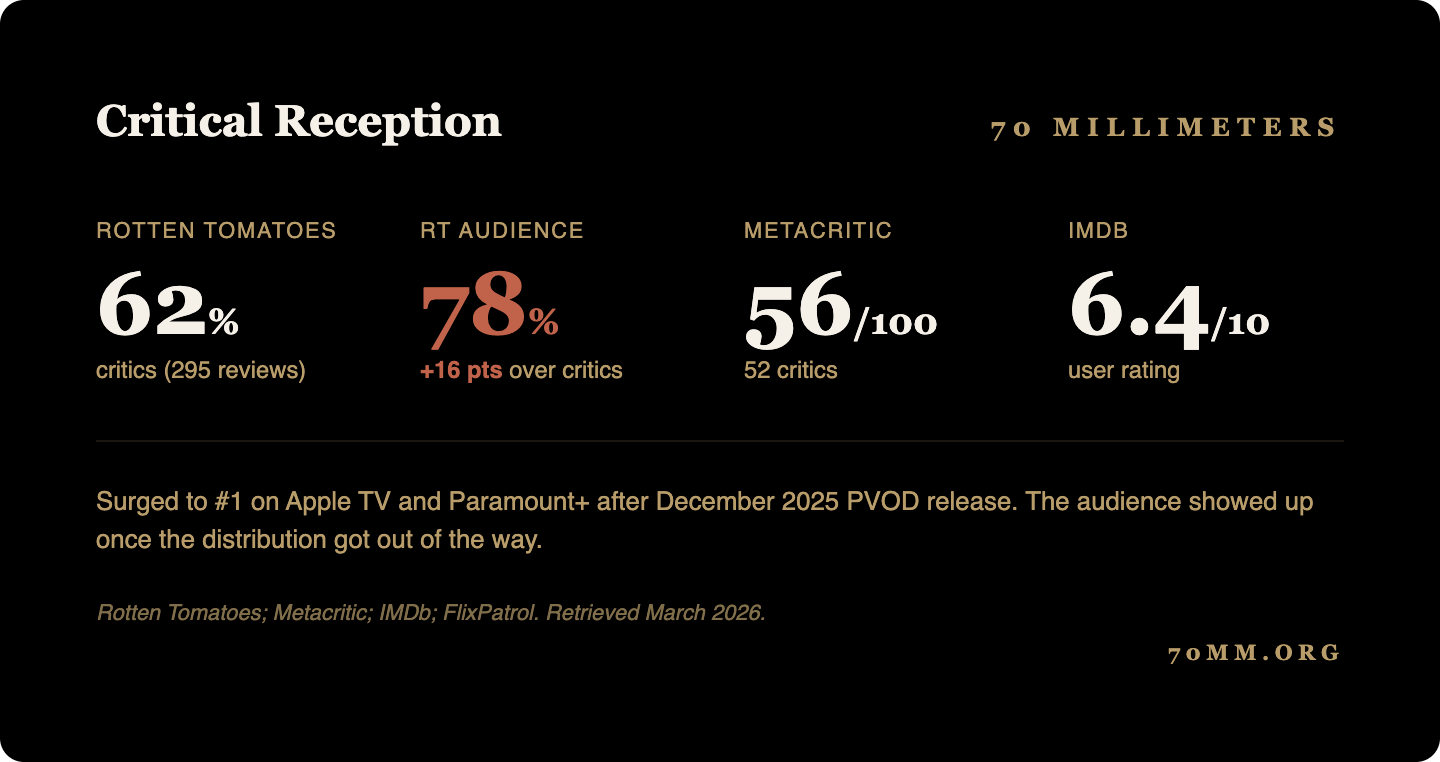
Why are reviewers, podcasts, youtubers panning The Running Man?
It’s because that is their industry. They love what they’re paid to love, hate what they’re not paid to love. Worst, and most dangerous, is unsettled spirit in them when they are not paid, because then they are neither authentic or a merchant. They are a sneer at scale.I am not knocking people who found the movie unfulfilling, because many of them loved the movie but wanted something a little more, a sentiment I agree with. Glenn Powell is amazing, I wanted just a little more OOMPH. — Adam Townsend
If it counts for much, Stephen King gave Wright his approval:


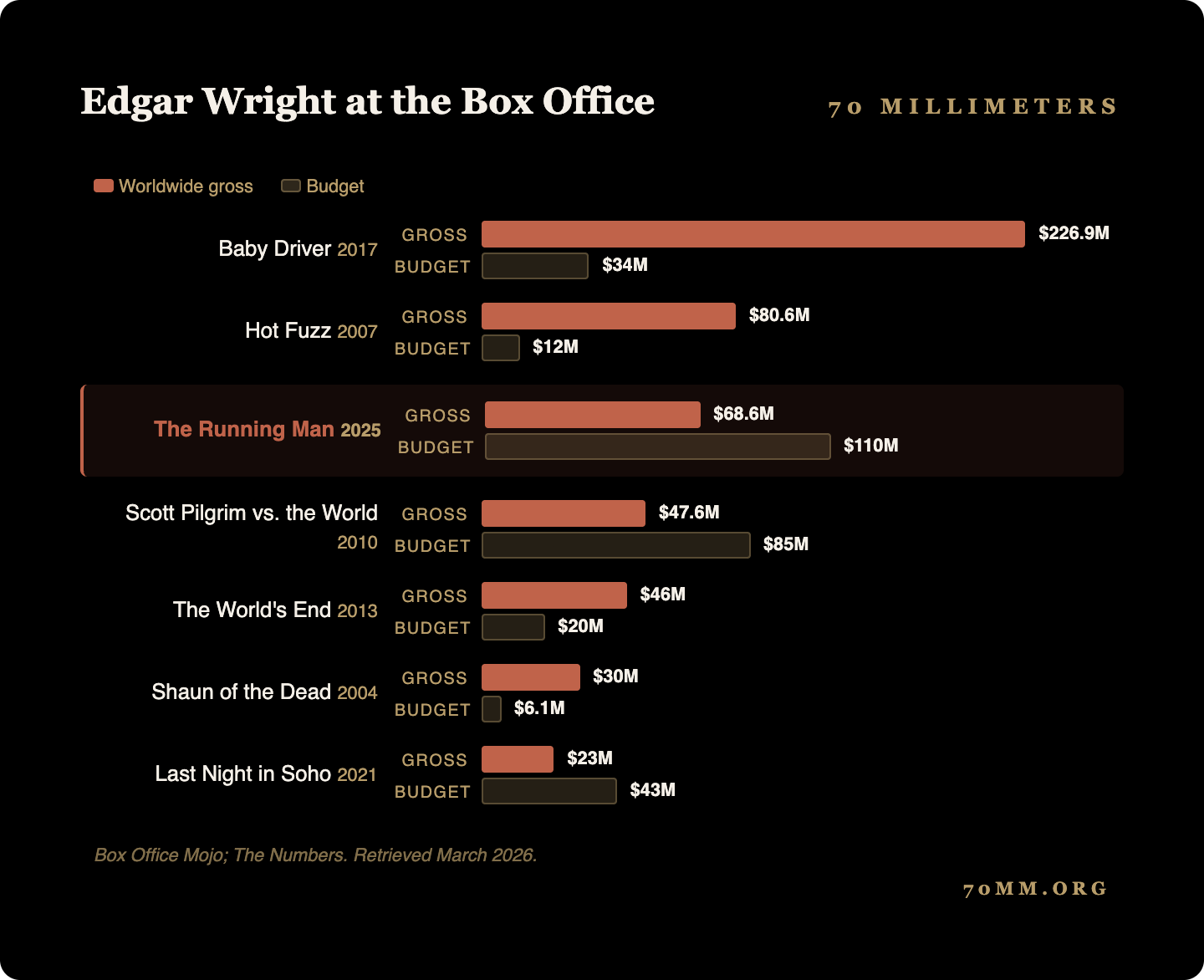
Paramount couldn't figure out how to sell it. Is it a dystopian thriller? A satirical action movie? An Edgar Wright genre experiment? Marketing dollars got cut when audience diagnostics looked soft, and the release date bounced around the calendar before landing in a November slot that satisfied nobody. Once it hit Paramount+, it surged to the top on streaming. Because when people actually watch the thing, they have fun. This is a film that got killed by its own distribution strategy and an annoying critical class. It would’ve been better off as an October release around Halloween. I’d like to think that if you give it five years, more people will talk about it. I hope Glen Powell gets more opportunities in action movies.
This was reminiscent of David Fincher's The Game with Michael Douglas. Both are about men trapped in elaborate systems designed to destroy them. The Game had more varied locations. But The Running Man is better paced, better presented, and its vision of how media and power intersect feels more urgent. And Glen Powell was more fun to root for than Michael Douglas.
For a dark comedy conspiracy thriller, The Running Man achieves everything it sets out to do. It held me at the edge of my seat with the constant anticipation of fight or flight. What else can you ask for?