

There are two people in Hollywood right now leading the fight for the theatrical experience. Two people who will spend years of their lives and hundreds of millions of dollars to make you feel something that your couch can’t replicate. Two people who would rather flip a real truck on a real street or fly a real jet through a real canyon than let a computer do it for them.
Tom Cruise and Christopher Nolan have never worked together. That might be the single biggest missed opportunity in modern cinema.
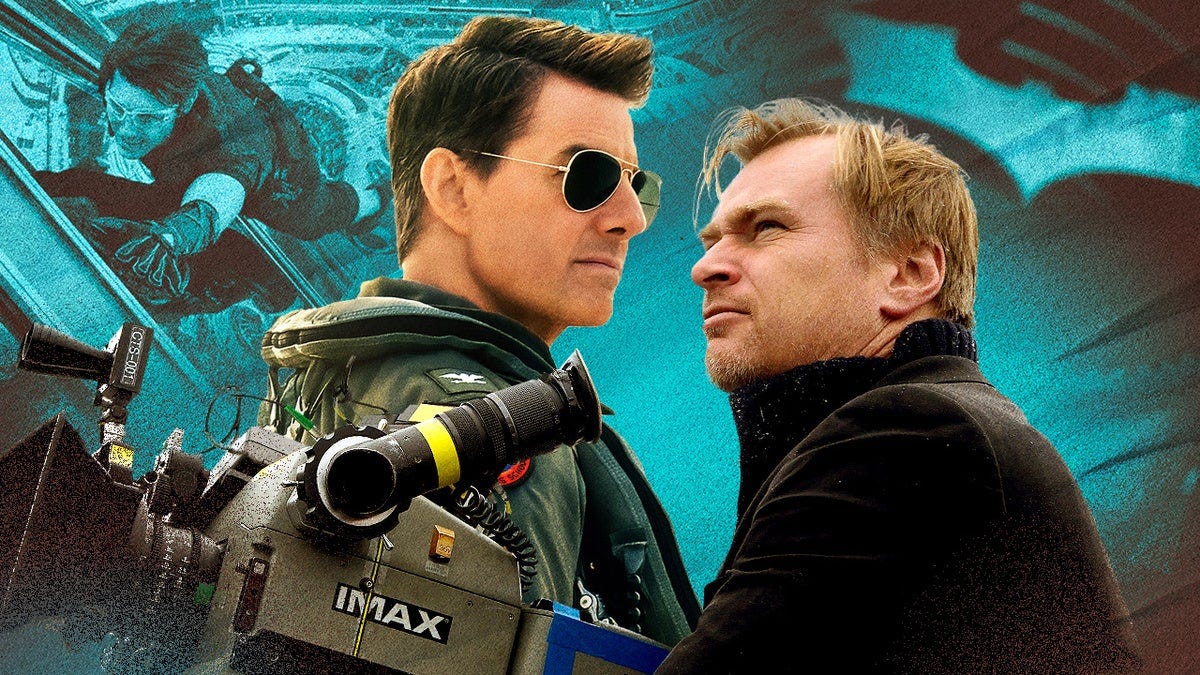
The overlap between these two is absurd. Both are obsessive about practical filmmaking. Both have staked their reputations on the idea that audiences can tell the difference between something real and something rendered. Both negotiate backend deals that give them a piece of the gross, which means both have a financial incentive to put people in seats, and both deliver on it. Both are among a vanishingly small group of names that can open a movie on reputation alone. Both have pushed the boundaries of visual storytelling and action filmmaking in the past 15 years. Your aunt who sees three movies a year will go see a Tom Cruise movie. She’ll also go see a Christopher Nolan movie. There might be five people left in the industry who can make that claim. Two of them are these guys.
“You saved Hollywood’s ass and you might have saved theatrical distribution. Seriously, ‘Top Gun: Maverick’ might have saved the entire theatrical industry.” — Steven Spielberg (speaking to Tom Cruise, 2023 Oscar luncheon)
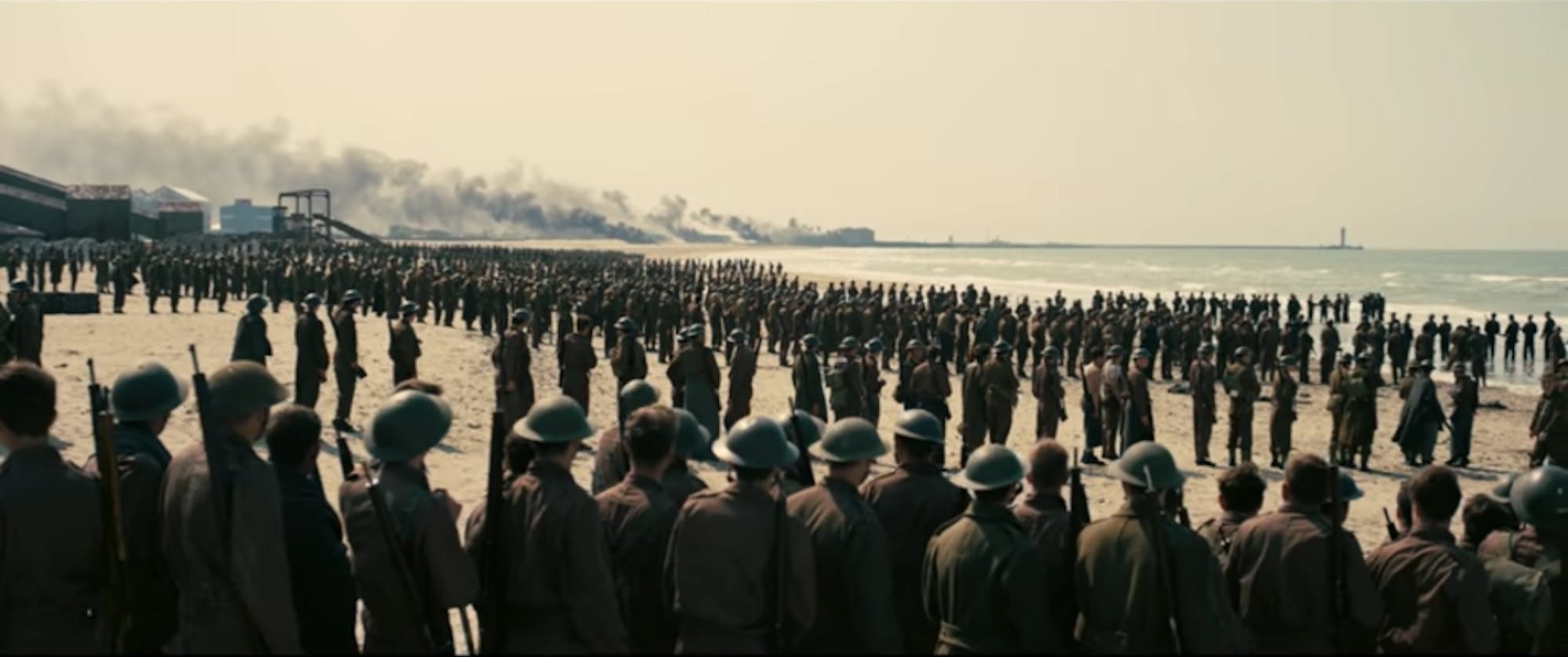
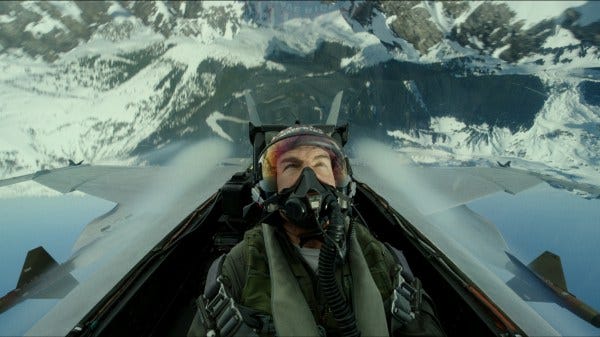
And between them, they've produced the greatest action and technical filmmaking of our generation. Top Gun: Maverick put real actors in real F/A-18s pulling real Gs, and the footage looks like nothing that has ever existed in a movie before. Mission: Impossible: Fallout is the most physically ambitious action film of the 21st century, a movie where the lead actor broke his ankle on camera, got up, and kept the shot. On the other side, Nolan gave us The Dark Knight, which redefined what a superhero film could feel like in IMAX. He gave us Dunkirk, which used IMAX film to put you on that beach so viscerally that veterans walked out of screenings shaking. Even Tenet, whatever you think of its story, is a technical achievement: practical sequences running forward and backward simultaneously, shot in-camera, on real locations, in IMAX. Their obsessions run parallel but point in slightly different directions. Nolan is consumed by the camera itself, by mounting IMAX where IMAX has never been mounted, by capturing images so large and so detailed that they become physiological experiences. Cruise is consumed by the action, by being the body in the frame, by making sure the person on screen is actually doing the thing the audience is watching. Both make you feel it in your gut.
“My preference is always to do things in-camera as much as possible. It sets a big challenge for every department to actually bring the reality of the thing there for the actors… the more things can just be real, the better they’re going to feel to the audience.” — Christopher Nolan
They are mirror images of the same phenomenon. Nolan is one of the only directors working today whose name sells tickets the way a movie star’s does. Cruise is one of the only stars who functions like a director, shaping the script and production of every film he’s in as of late. And both of them have the box office receipts to prove it.
One could argue they each have a gap that the other person fills. And yet, somehow, the conversation about a Cruise-Nolan collaboration barely exists. People talk about it online the way you’d talk about time travel. Nice idea, never happening.
Two Philosophies, One Religion
Cruise and Nolan arrived at the same destination from completely different directions. Nolan came up as a writer-director, an architect of narrative. His obsession with practical effects is an extension of his obsession with control over every frame. When he crashes a real Boeing 747 into a building for Tenet, or detonates a practical recreation of the Trinity test for Oppenheimer, it's because he believes the camera registers reality differently than it registers simulation. And he's grown technically over the years in a way that's worth tracking. From the neo-noir grit of Following to the IMAX-native spectacle of Dunkirk and Oppenheimer, there's a clear line of escalation. Each film pushed the format further, demanded more of the camera, and found new ways to make scale feel personal. By Oppenheimer, he was shooting conversations in IMAX and making them feel as monumental as any explosion he'd ever staged.
Cruise came from the opposite end. He started as an actor. And here’s something I think gets overlooked: he might be the only major star in Hollywood history who began as a legitimate character actor and evolved into an action icon, rather than the other way around. Think about his run through the ‘80s and ‘90s. The Color of Money with Scorsese. Rain Man with Levinson. Born on the Fourth of July for Stone. A Few Good Men, Jerry Maguire, Magnolia, Eyes Wide Shut for Kubrick. He was working with every canonized director in the business, turning in performances that had nothing to do with hanging off helicopters. The guy was robbed of a Best Actor Oscar for Jerry Maguire, and his work in Magnolia is as raw and unhinged as anything you’ll see from any actor of his generation.
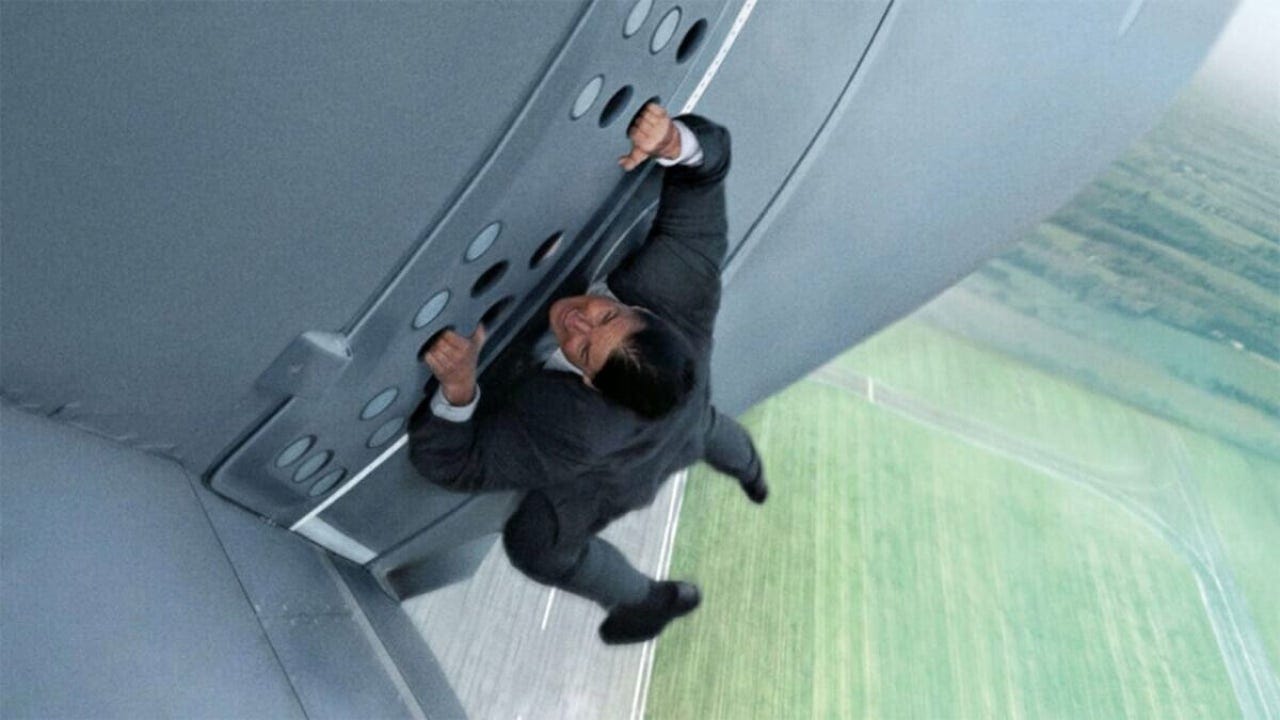
Then something shifted. The Mission: Impossible franchise became his vehicle, and over the course of eight films, he turned himself into the most committed practical action filmmaker alive, from the cockpit, the cliff edge, the side of an airplane at 5,000 feet. What he achieved physically in these films is completely unique. The HALO jump in Fallout, shot at 25,000 feet over Abu Dhabi with Cruise actually jumping over 100 times to get the shot. The helicopter chase in the same film, which Cruise flew himself after logging thousands of hours of flight training. The motorcycle cliff jump in Dead Reckoning, which required him to ride off a 4,000-foot cliff in Norway and deploy a parachute mid-fall, a stunt so dangerous they built a ramp on the side of a mountain and he did it six times. These are real things a human being did in front of a real camera. No other actor in the history of the medium has committed to this level of physical filmmaking.
But somewhere in this transformation, the franchise's recent returns reflect the toll of a production process that stopped working. To be fair: Dead Reckoning and The Final Reckoning were both hampered by forces partly outside Cruise's control, (much like Tenet for Nolan). The pandemic blew up the original production schedule for MI7. The 2023 writers' and actors' strikes froze development at critical moments for the last installment. But a self-inflicted problem would also exist: both films went into production without completed scripts. Scenes were being written and rewritten during shooting. Story threads were being figured out on the fly, with a budget clock running. Dead Reckoning made $571 million on a $291 million budget, which sounds fine until you do the math on marketing and distribution. The Final Reckoning cost a reported $400 million and topped out under $600 million worldwide. These are films that need a billion dollars to justify their existence, and they're not getting there. The action is still extraordinary. Cruise lit his parachute on fire sixteen times for a single stunt. But when you're writing the story while you're building the set, the writing suffers. The stories were running on fumes.
“I love making movies. It’s not what I do. It’s who I am.” — Tom Cruise (People magazine, 2025)
This is where Nolan's approach could help. Nolan shows up on day one with a finished script. Every shot is planned. Every timeline is mapped. Every set piece is designed to serve the narrative, not the other way around. That discipline is central to his production strategy. Completed scripts mean accurate budgets. Accurate budgets mean controlled costs. Controlled costs mean you hit your release window. Nolan's films come out when they're supposed to come out. They don't slip. They don't balloon. Nolan takes pride on undershooting his budget, and is a lot more careful asking for money from studios (which is why he seemingly commands an even higher percentage of first dollar gross than Cruise). Oppenheimer was budgeted at $100 million, shot on schedule, and released on its announced date. It made $953 million and won seven Oscars.
Imagine Cruise having a full script before the cameras roll.
Where Cruise Helps Nolan
Nolan’s films are structurally brilliant, visually staggering, but can be emotionally distant. Tenet is the clearest case: a film of breathtaking ambition with a main character so opaque that audiences couldn’t find an emotional anchor. John David Washington is a talented actor, but the Protagonist, literally unnamed, is a function of the plot rather than a person you’d follow off a cliff. Dunkirk deliberately stripped character out of its structure, and while that worked for its purpose, it left audiences admiring the craft more than aching for the people.
The exceptions prove the rule. Inception‘s Cobb is warmer because DiCaprio brought his own gravity to the role. Cillian Murphy in Oppenheimer is Nolan’s most human protagonist because Murphy’s face can carry the weight of a civilization in a single close-up. But Oppenheimer isn’t an action film. Nolan’s challenge has always been marrying his architectural storytelling to protagonists who make you feel something physical, who make you grip the armrest not because the set piece is impressive but because you’re terrified for that person.
Tom Cruise is the answer to that problem. His entire screen presence is built on making you follow him off a cliff. When he runs, you run. When he’s hanging off the side of a building, your palms sweat. He brings decades of earned audience trust. Cruise makes you care about the body on screen in a way that very few actors in history have managed. Put him inside a Nolan narrative, inside one of those intricate structural puzzles, and suddenly you have a film where the architecture has an emotional heartbeat.
And Nolan is the answer to Cruise’s problem. After eight Mission: Impossible films, Cruise could use a script completed before filming that matches his physical commitment. Nolan is among the best structural screenwriters working in commercial cinema. He builds narratives like an engineer: every load-bearing element in its precise place, every timeline folding into every other timeline, every reveal earning its moment. That rigor, applied to a character Cruise would inhabit physically, is the pinnacle of what realistic filmmaking can be.
Listening to either of Cruise or Nolan talk about their films is infectious. Look at how Cruise discusses his water tanks in Final Reckoning around the 7 minute mark of this interview. So meticulous. So obsessed.
Nolan’s interviews are all the same. For example, his explanation of the making of Memento is phenomenal:
Dead Reckoning, Oppenheimer & IMAX Drama
If there’s a practical reason this collaboration hasn’t happened, perhaps the summer of 2023 is a good place to start looking. Dead Reckoning Part One opened on July 12th. Oppenheimer opened on July 21st. Nine days apart. And Nolan’s team at Universal had locked down every IMAX screen in North America for Oppenheimer‘s first three weeks, which meant Cruise’s film got bumped from the premium format after barely a week.
Nolan shot Oppenheimer on native 65 mm IMAX film with Hoyte van Hoytema. Dead Reckoning was shot on the Sony CineAlta Venice, which is an IMAX-certified digital camera but not native to the format. Oppenheimer had first dibs. Dead Reckoning was only in the conversation because of delays, and Paramount refused to move their dates.
Still, Cruise had a right to be frustrated. Here’s a guy who had just saved theatrical distribution one year earlier. Cruise declined every streaming offer during the pandemic and held out for a theatrical release. He put his money where his philosophy was. Nolan, to his credit, had tried the same thing with Tenet in 2020, releasing it into a pandemic to try to lure audiences back to theaters. It didn’t work the way he hoped. Tenet made $365 million globally, Nolan’s lowest return since The Prestige. Cruise waited, released Maverick in 2022, and it made $1.49 billion. He finished the job Nolan started.
“I think IMAX is the best film format that was ever invented. It’s the gold standard and what any other technology has to match up to, but none have, in my opinion.” — Christopher Nolan (DGA Quarterly interview)
I understand the sting. These two were supposed to be on the same side. In a lot of ways, they are the same side. Two of the last people standing between the theatrical experience and a future where everything premieres on your phone.
But here’s what Cruise did next, and this is why I think the man is genuinely something special: he promoted Oppenheimer. The movie that had just stolen his IMAX screens. He showed up on social media and told people to go see it. Because Tom Cruise cares about people going to the movies. Shoutout Adam Townsend, the founder of the Tom Cruise Day of Visibility, and the man who put me onto Cruise’s genius recently and inspired the creation of this blog, for suggesting this is part of Cruise’s “Hollywood visibility campaign.”


This is where I start to get a little frustrated with Nolan, and I say this as someone who grew up watching his films. Batman Begins shaped how I think about movies. The Dark Knight is one of the best films ever made. Inception, Interstellar, Dunkirk, Oppenheimer: I have seen them all multiple times in IMAX. Christopher Nolan is one of the most important filmmakers alive.
But the man does not give Tom Cruise enough credit.
Cruise promotes everything. He showed up for Tenet when it launched into a dead marketplace. He promoted Oppenheimer and Barbie when both were competing with his own film. He went to a screening of Sinners and posted about it, telling people it’s a must-see in a cinema. He showed up at the UK premiere of Edgar Wright’s The Running Man and publicly championed Glen Powell, a guy he mentored on Top Gun: Maverick. Powell has said Cruise was the first person he called when he got cast, because Cruise taught him how to run on camera. Spielberg has praised him. Michael B. Jordan lights up talking about meeting him. Ryan Coogler has said publicly how much Cruise’s support meant for Sinners. Cruise is the unofficial ambassador of theatrical cinema. He’s doing the work.
“You’re not going to feel as connected with the character if I went with a regular mask and a thing in my mouth to breath. Luckily when you’re flying jets you train for hypoxia and for carbon dioxide buildup. You start to be able to perceive your body and how it’s reacting so that I knew when to stop.” — Tom Cruise (People magazine, 2025)
Where is Nolan in this? Nolan talks about Kubrick. He talks about Michael Mann. He talks about.. Ridley Scott’s Gladiator II? I can’t recall a single instance of Nolan publicly praising Tom Cruise’s contribution to practical filmmaking or theatrical exhibition. The guy who arguably did more than anyone to keep theaters alive during and after the pandemic. The guy whose aerial sequences in Top Gun: Maverick rival anything Nolan achieved in Dunkirk. The guy who has been championing IMAX and physical filmmaking for two decades. Not a word.


Maybe that’s just how Nolan operates. He’s private. He does his own thing. He doesn’t play the public mutual-admiration circuit. Fine. But when you’re one of the two most important voices advocating for theatrical cinema, and the other voice is out there promoting everyone else’s work, the silence is noticeable.
What’s Stopping Collaboration?
The real obstacle to a collaboration is probably simpler than ego or rivalry. Both men think in decade-long arcs. Cruise imagines sequences years before they’re filmed, building the physical training and logistics required to execute a single stunt. Nolan writes scripts on timelines that stretch far beyond normal development cycles, constructing narratives with the patience of someone who knows the audience will wait. Any collaboration requires both of them to want it at the same time, and for two people who plan this far ahead, finding a window where those arcs align is actually a harder problem than the money. Two orbits that have to intersect at precisely the right moment, and neither person is in the business of adjusting their trajectory for anyone else.
And the money is hard. Cruise commands a 20+ million dollar salary plus about 10% first dollar gross. Nolan commands similar compensation upfront, and 15-20% first dollar gross. On Minority Report, Spielberg solved this exact problem: he and Cruise both waived their upfront salaries and took 15% of the gross each, keeping the budget under $100 million. The film made $358 million. Both got paid handsomely. Spielberg’s framing was explicit: “I haven’t taken a salary in 18 years for a movie, so if my film makes no money I get no money. They should be prepared to do the same.” It was a gamble, and it worked because the two biggest names in the industry bet on each other instead of against each other. For War of the Worlds, Cruise took 20% of the gross and no upfront salary, ultimately earning around $100 million on a film that made $603 million.
That template exists. Cruise and Nolan could replicate it. Two people taking a percentage of the gross on a film that both their names are selling? On a practical-effects-driven IMAX spectacle written & directed by Nolan and physically embodied by Cruise? That film makes a billion dollars. The math works if the egos can.
“The thing with computer-generated imagery is that it’s an incredibly powerful tool for making better visual effects. But I believe in an absolute difference between animation and photography. However sophisticated your computer-generated imagery is, if it’s been created from no physical elements and you haven’t shot anything, it’s going to feel like animation.” — Christopher Nolan
Another question is creative control. Nolan writes his own scripts. He designs the story, the structure, the visual grammar. His actors serve the narrative. He doesn’t make Tom Cruise movies. He makes Christopher Nolan movies. Cruise, on the other hand, has spent two decades building a system where he is the creative engine. He develops the stunts. He shapes the action sequences. He’s the producer, the star, and in many ways the architect of how his films look and feel. The Mission: Impossible franchise works because Cruise is the auteur, regardless of whose name is on the director’s chair.
“Anytime you see Tom in the plane, he’s at the controls,” says director Christopher McQuarrie, who has helped helm every Mission film since 2015’s Rogue Nation and co-wrote the seventh and eighth installments with Erik Jendresen. “He’s basically a one-man film crew: operating the camera, acting and flying.”
So who leads?
This is where the Kubrick precedent matters. Eyes Wide Shut is an example we have of Tom Cruise genuinely surrendering to a director’s vision. Kubrick was the most controlling director in the history of the medium. He shot that film for over 400 days. He demanded take after take after take. He reshaped the production schedule around his obsessive standards and expected total submission from everyone on set. Cruise gave it to him. Completely. The result is one of the most haunting, psychologically layered performances of Cruise’s career. A performance that has nothing to do with running or jumping or hanging off things. Bill Harford wandering through that New York night, out of his depth, out of control, slowly realizing that the world he thought he understood is something else entirely. That’s acting. That’s the Tom Cruise people forgot existed.
Kubrick appealed to the actor beneath the movie star. And Cruise, who by that point was already one of the biggest stars on Earth, let himself be directed in a way he hasn’t allowed since. The guy who controls every aspect of every Mission: Impossible production walked into Kubrick’s world and became a tool of the director’s vision.
Nolan operates with similar authority. His sets, his timelines, his rules. The actors who thrive under him are the ones who trust the structure he’s built and bring their internal work to it. Murphy did it. DiCaprio did it. Downey did it. Can Cruise do it again? He’s reportedly looking to. Variety reported in 2024 that he wants to return to working with auteurs. He’s doing a film with Alejandro González Iñárritu. But Nolan is the more interesting prospect, because of his obsession with practical high budget filmmaking. How would he go about this with Cruise?
That question is worth a movie. Nolan would get something he’s never had: an action protagonist whose screen presence and blockbuster sensibilities create the emotional connection his narratives sometimes lack. Cruise would get something the Mission: Impossible franchise stopped giving him towards the end: writing rigorous enough to match what his body does on screen.
Two Sides of the Same Coin
I grew up on Nolan. He taught me what cinema could be when it was operating at the highest level of ambition. Discovering Cruise’s body of work later, especially the Mission: Impossible films from Ghost Protocol forward and then working backward through his ‘90s run, felt like finding the other half of the same argument. These two people believe the same things about what movies owe an audience. They execute on that belief with a rigor that nobody else in Hollywood consistently matches outside Denis Villeneuve, or Joseph Kosinski who did brilliant work with Top Gun: Maverick and showed similar instincts with F1.
The industry is full of people making content. Algorithmic products designed to be consumed on a tablet at 1.5x speed. Franchise entries that look like they were color-graded by a committee. Disney’s assembly-line visual mediocrity. Marvel’s washed-out palettes. Cruise and Nolan are the antidote to all of it, and they’re fighting the same war from different foxholes.
They should be in the same foxhole.
Cruise is 63 years old. He’s still doing his own stunts, still flying his own jets, still getting new licenses and pushing boundaries. But the window isn’t infinite, and the Mission: Impossible franchise ended with diminishing returns on escalating budgets. The next phase of his movies need to deliver at the box office. Nolan is 55 and operating at the peak of his powers, coming off an Oscar sweep and heading into what looks like the most ambitious production of his career with The Odyssey. Both men plan years ahead. Both are probably already thinking about what comes after their current projects. The question is whether those timelines ever converge, whether two people who think in decade-long arcs can find a window where the arcs overlap.
“I’m going to make movies into my 80s; actually, I’m going to make them into my 100s. I will never stop. I will never stop doing action, I will never stop doing drama, comedy films.. I’m excited.” — Tom Cruise (The Hollywood Reporter, 2025)
I don’t know if it’ll ever happen. Maybe the competitive energy between them is actually productive. Maybe the best version of this story is the one where they keep pushing each other from a distance, each one raising the bar for the other.
But I don’t think so. I think the best version of this story is the one where somebody picks up the phone. Where Cruise walks onto a Nolan set and submits to something bigger than himself, the way he did for Kubrick 27 years ago. Where Nolan writes a character who demands the kind of physical presence that only one person on Earth can deliver, and gives that character a story for the ages. Where two people who have spent their careers proving that audiences deserve reality decide to give them the most real thing cinema has ever produced.
I’ll be in the IMAX seat. I won’t be checking my phone.