

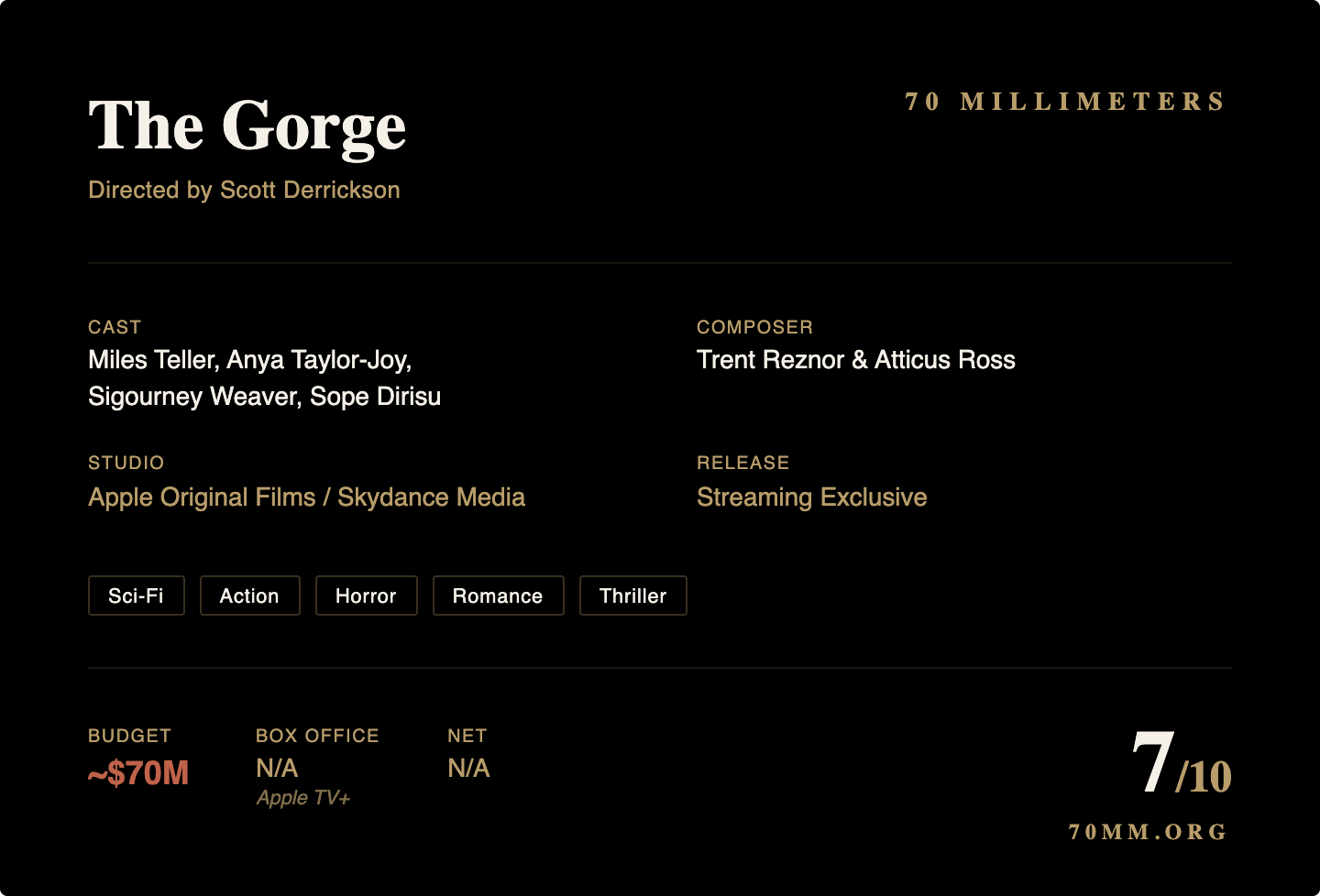
7/10 (Spoiler Free)
The Gorge is one of the best-looking movies you'll stream, a genre pile-up that wants to be a horror film, a romance, an action thriller, and a conspiracy movie all at once. It succeeds most at the things Apple does best: making beautiful objects that make you forget you're staring at a screen. The story runs out of ideas before the camera does, but for two hours, you won't care as much as you'd expect. A fascinating entry when considered within Apple TV’s new movie strategy.
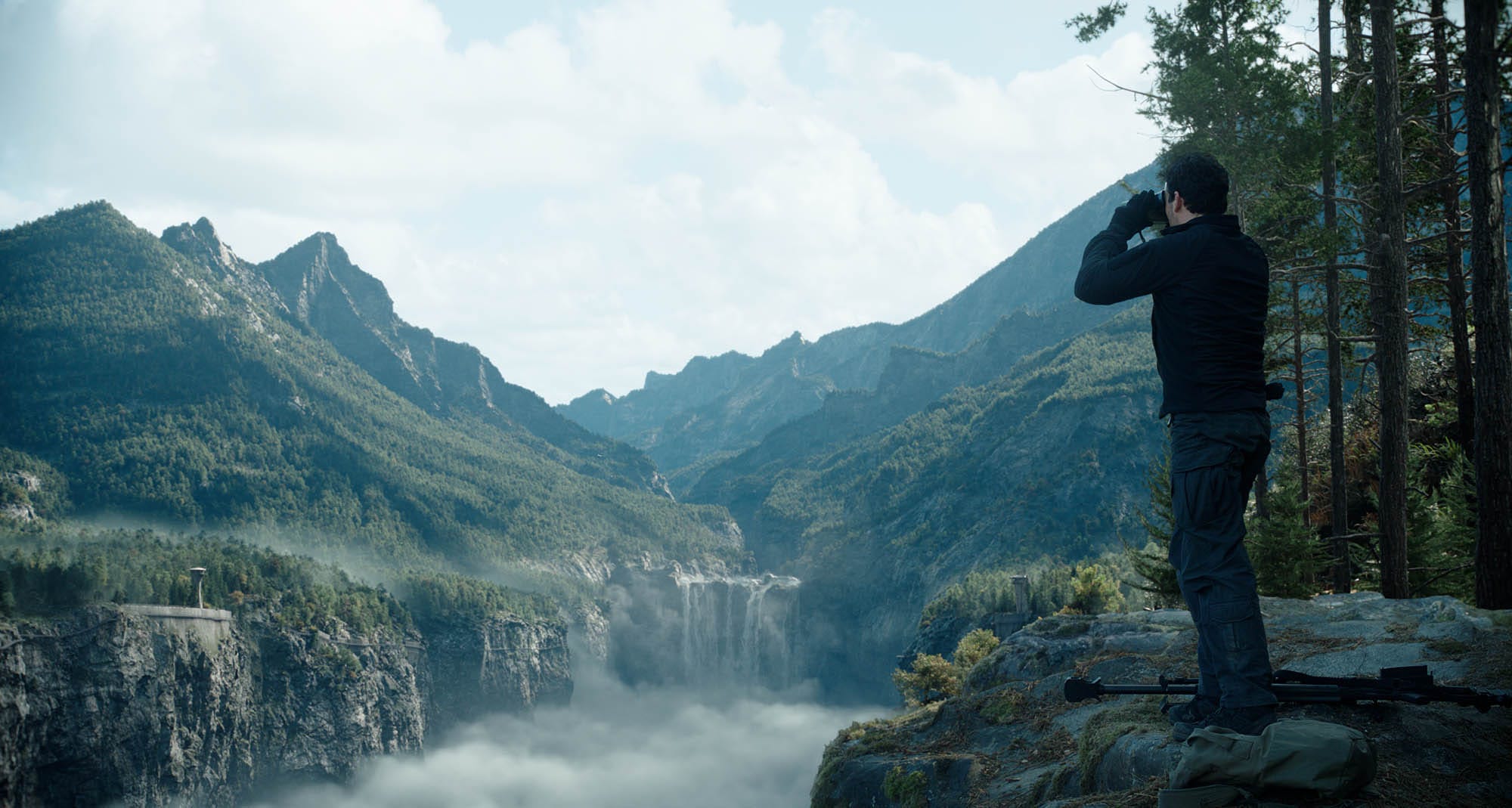
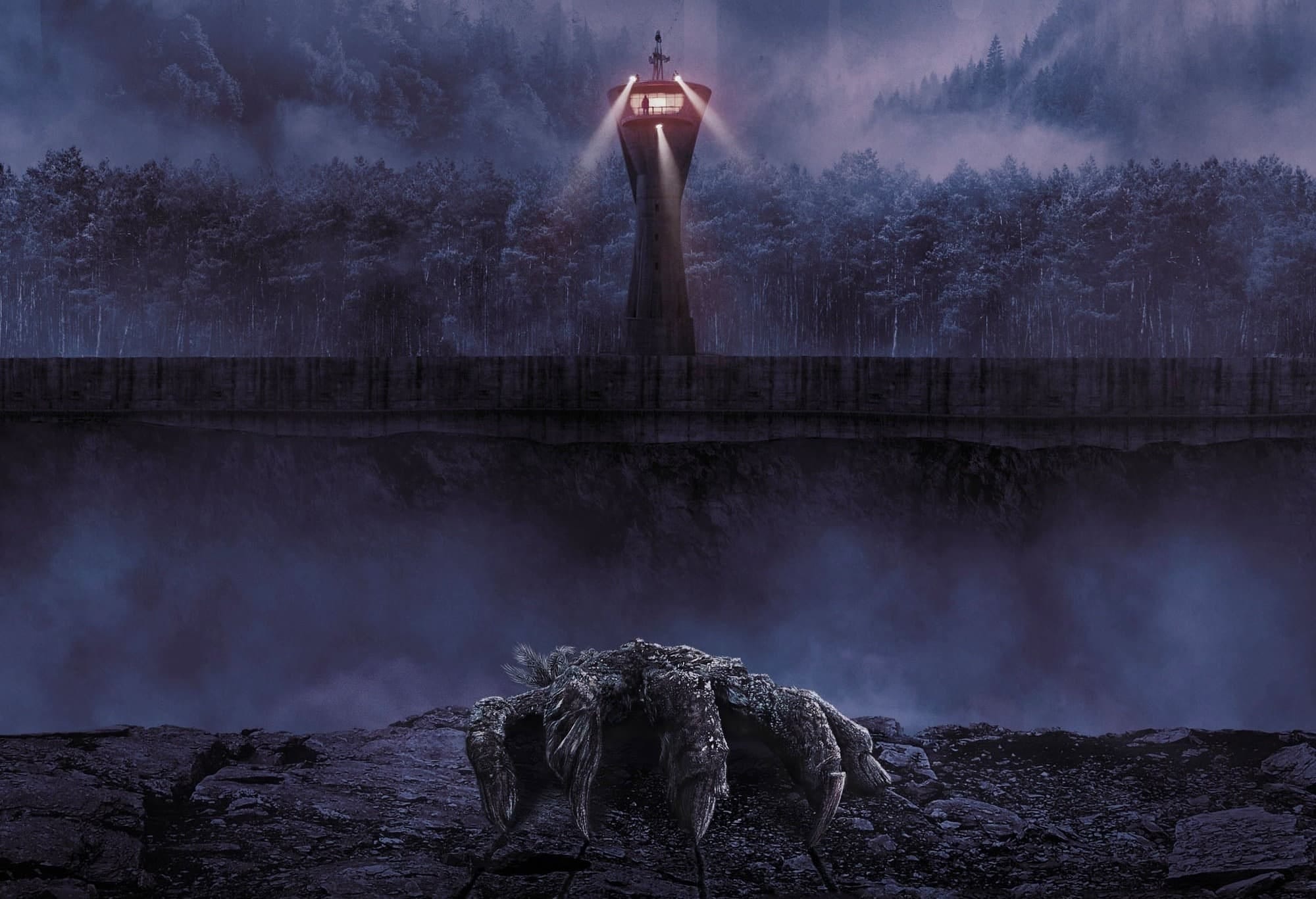
The Gorge is stunning in a way that streaming movies almost never are, the kind of film where you pause to stare at a wide shot of Norwegian forest and wonder why you’re watching it on your couch instead of an IMAX screen. The gorge itself, a mist-choked abyss flanked by concrete guard towers and lined with automated turrets, is one of the better pieces of world-building I’ve seen in a recent genre film. The technology, the protocols, the surrounding wilderness. The unlimited wild game. Scott Derrickson builds a place you believe in.
The premise gives you two elite operatives stationed in guard towers on opposite sides of a vast, classified gorge, tasked with keeping something contained. The first half is where the film is sharpest, a slow-burn that lets its world breathe and its characters find each other across an impossible distance. The setup is genuinely excellent. The second half is where the genres start colliding, and the film gets busier than it needs to be. Horror bleeds into action bleeds into conspiracy thriller, and while each piece is competent, the pile-up dilutes what made the opening so effective. If they’d narrowed the scope even slightly, this could have been something special instead of something solid.
The horror works in bursts. Jump scares, mostly, and a few of them land. But The Gorge is not pure horror. Here, the horror is more of a set dressing for the action, and the action is more of a vehicle for the romance, and the romance gives way to a conspiracy thread that gets more predictable the longer it goes. You see the problem. The movie is trying to be four things at once, and while it manages to be competent at all of them, it’s great at none of them.
Except the visuals. The visuals are great.
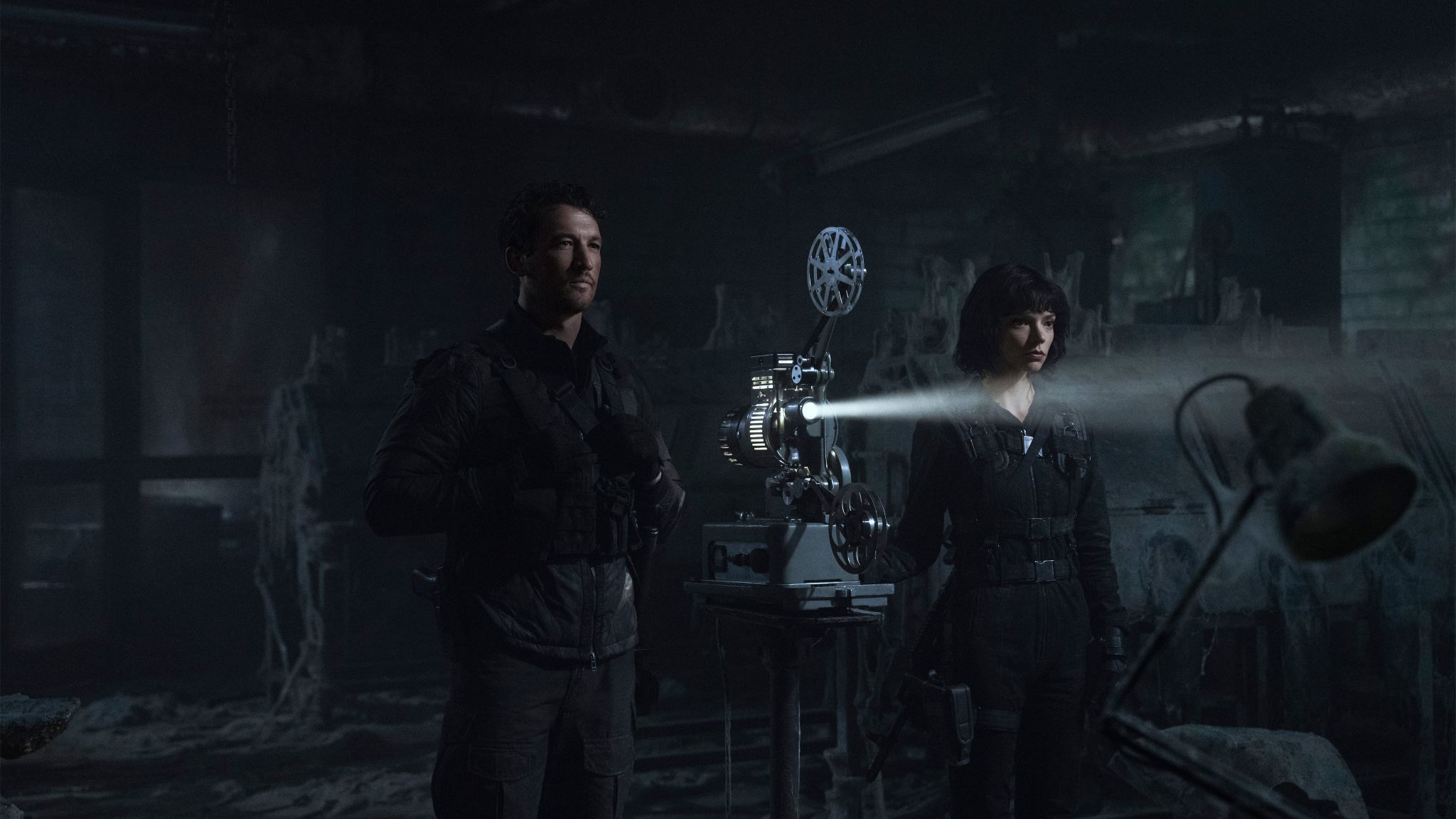
Miles Teller plays the American operative, and he’s the right guy for this. Teller has always been best when a role asks him to be smart and a little damaged, and this one gives him both. You invest in him early, during the handoff scene with Sope Dirisu, who explains the rules of the gig with the weariness of someone who’s been alone too long. Dirisu is terrific in limited screen time.


Anya Taylor-Joy plays the operative on the other side, a Lithuanian covert specialist with close-cropped black hair and a cute accent. She’s well cast here, physical in the action sequences, and watching her move through fight choreography makes you understand why Villeneuve tapped her for Alia Atreides. If The Gorge is any indication, she’s going to be something in Dune 3.
The two leads have genuine chemistry, which matters because so much of the film depends on you buying their connection before they ever share a physical space. It’s charming. The script, by Zach Dean, who wrote this as a spec that landed on the 2020 Black List, is sharpest in these quieter early stretches. There’s a Christmas montage where they play chess and bang on improvised drum sets across the gorge, a nod to Taylor-Joy’s breakout in The Queen’s Gambit and Teller’s in Whiplash. The references were in the script before either actor was cast. Both tried to get the scene cut. The producers overruled them. They were right to. That was iconic.
Sigourney Weaver shows up as their handler, and she brings the right energy. It’s a small role, but Weaver has been doing menacing government types since before most of this cast was born, and she doesn’t waste a line.
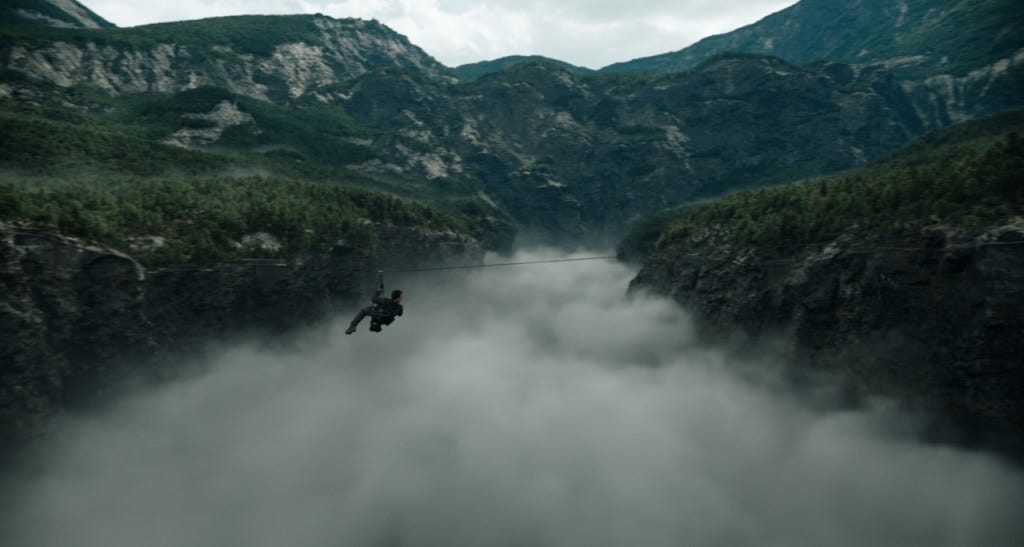
The visuals are everything. Derrickson and cinematographer Chris Soos, who came up shooting music videos for David Bowie and the White Stripes and Marilyn Manson, give the film a neo-noir quality that’s genuinely stunning. The forest exteriors, shot along Norway’s Rauma River, are pristine. Beautiful pines and granites. The movie has a Steve Jobs quality to it. Apple’s visual brand, the obsession with clean lines and light falling just so, bleeds into the way this movie looks. Darkness inside the gorge contrasts with the hyper-sharp greens above, and the towers are always well framed. Even the VFX, handled by DNEG and Framestore, have a tactile quality that most streaming-exclusive films don’t bother with. They spared no expense.
Which brings me to Apple.
The Gorge became Apple TV+’s biggest movie launch ever, beating out Wolfs with Clooney and Pitt. It drove double-digit subscriber growth globally and boosted new viewers by 80% the weekend it dropped. All of this as a streaming exclusive, without a theatrical window or an Oscar campaign or months of festival buzz. A Valentine’s Day debut and strong word of mouth.
This is the new Apple playbook, and it’s fascinating. For years, Apple tried to be a prestige studio. They bankrolled Killers of the Flower Moon, Napoleon, Argylle, Fly Me to the Moon. The results were mixed at best. Scorsese’s film earned ten Oscar nominations but struggled commercially. Napoleon divided critics. Argylle was a genuine bomb. The theatrical strategy was burning money without building the subscriber base that justifies the whole enterprise. So Apple pivoted. Streaming-first releases. Mid-budget genre films with recognizable casts. Movies designed to be watched on a Friday night on your couch, not debated at Cannes. The Gorge is the proof of concept. So was Highest 2 Lowest with Denzel and Spike Lee later that year, and The Lost Bus with McConaughey. Then F1 got a full theatrical run, grossed over $630 million worldwide, and proved Apple could do both when the project warranted it.
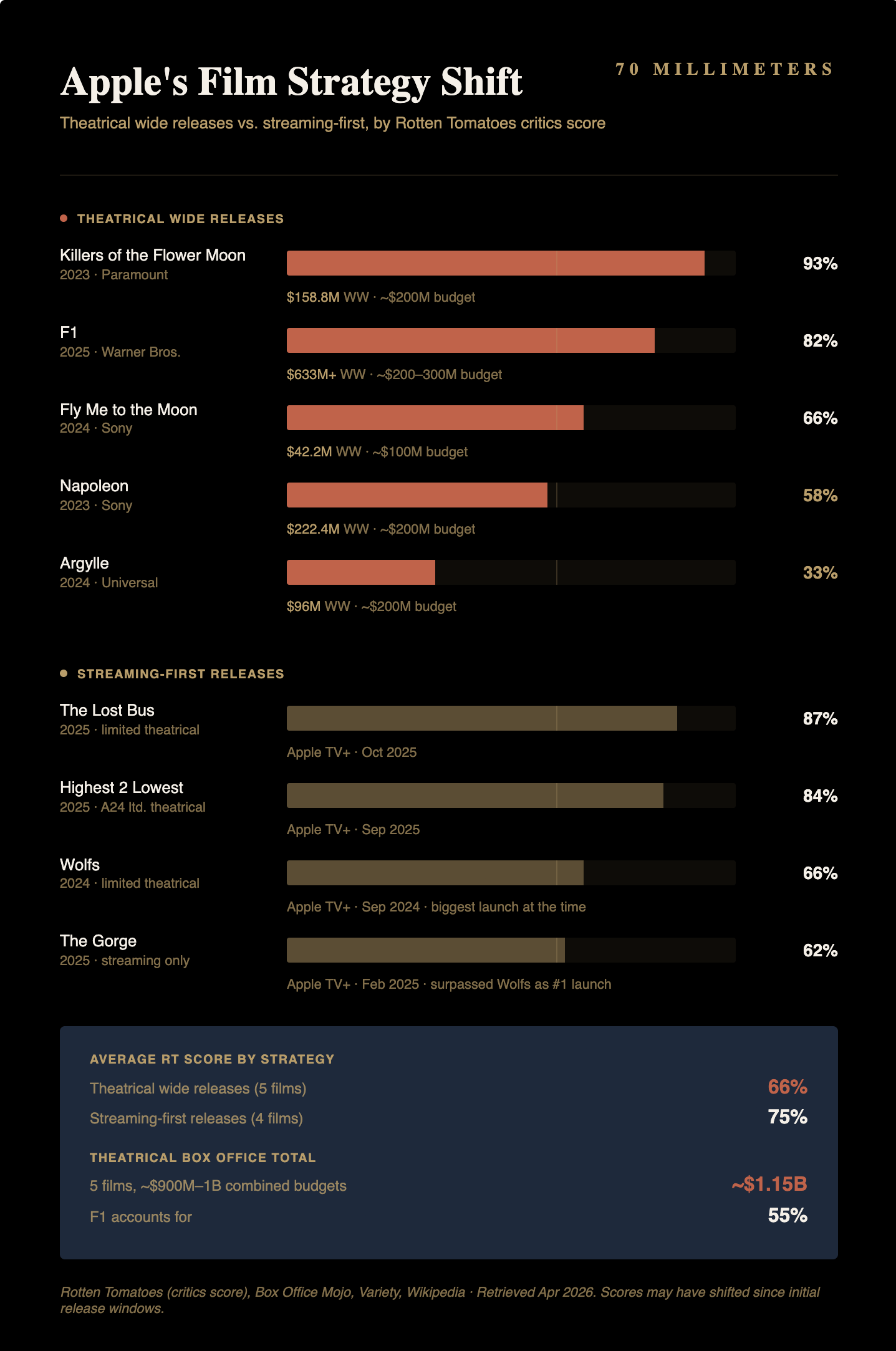
There’s something instructive about the fact that Apple’s biggest streaming hit isn’t their most critically acclaimed or their most ambitious. It’s the most watchable. The Gorge is a Friday night movie. It knows what it is. Two attractive people, a gorgeous location, cool technology, monsters, explosions, a kiss at the end. That combination, packaged at this level of visual quality, turns out to be exactly what streaming audiences want. The critics gave it a 62% on Rotten Tomatoes. Audiences gave it a 74%. That gap tells you everything about what this movie is doing and who it’s doing it for.
Apple’s strategy now is to spend big annually but keep budgets under $100M per film, reserve wide theatrical for only one or two titles a year, and use limited runs mainly for awards eligibility.
The Reznor and Ross score is not their most adventurous work. They produced a ten-track album runs 34 minutes. “Millipedes and Fire Ants” opens with a low buzz that builds into something organic and unsettling. “The Other Side” is the closest thing to a theme, a slow piano figure that plays whenever the two leads are communicating across the gorge. It does the job.
So what do you do with a movie like The Gorge? If you judge it as a visual experience, as a showcase for what a mid-budget streaming film can look like when Apple’s money and taste are behind it, it’s a 9. If you judge it purely on story, on whether the back half delivers on the front half’s promise, it’s closer to a 6. A gorgeous wrapper around an average story, and whether you love it depends on how much you like these genres. There’s definitely real craft here, real chemistry between the leads, and enough striking images to justify the two hours. I just wish the script was a little better. The gorge was interesting when it was mysterious. The deeper the movie went into it, the less there was to find.