

10/10
Christopher Nolan spent ten years building a heist film about the thing he does for a living: assembling specialists, constructing false realities, and smuggling ideas into your head while you sit in the dark. DiCaprio brings real grief to a role that could have been cold. The ensemble around him is one of the best in modern blockbuster filmmaking. Hans Zimmer's score might be the finest piece of film music ever composed. And the ending still starts arguments fifteen years later. This is peak Nolan, all his stars aligned at once.
Director: Christopher Nolan
Cast: Leonardo DiCaprio, Ken Watanabe, Joseph Gordon-Levitt, Tom Hardy, Elliot Page, Cillian Murphy, Marion Cotillard, Michael Caine, Tom Berenger, Dileep Rao
Composer: Hans Zimmer
Studio: Warner Bros. Pictures / Legendary Pictures
Budget: $160M | Box Office: $839M | Net: ~$400M
Genres: Sci-Fi, Heist, Thriller, Drama
Inception is a movie about planting an idea so deep inside someone’s mind that they believe it’s their own. It is also, if you tilt your head, a confession. Christopher Nolan spent ten years writing a heist film about the exact thing he does for a living: he assembles a crew of specialists, constructs an elaborate false reality, and smuggles feelings and ideas into your subconscious while you sit in the dark eating popcorn. The heist isn’t unfolding in the plot. The heist is the movie itself. And by the time the credits roll, the idea is already inside you.

DiCaprio plays Cobb, an extractor who enters people’s dreams to steal secrets. Nolan had a character named Cobb in his first feature, Following, a decade earlier. The two Cobbs share a certain quality: they’re men who’ve gotten too deep into the act of watching and infiltrating other people’s lives. This Cobb has a specific job to do. A powerful businessman named Saito, played by Ken Watanabe with a calm authority that makes you believe this man could buy an airline on a whim, hires Cobb not to steal an idea but to plant one. Inception. The team Cobb assembles to pull it off is one of the great ensembles in modern blockbuster filmmaking.
COBB: "What is the most resilient parasite? Bacteria? A virus? An intestinal worm? An idea. Resilient. Highly contagious. Once an idea has taken hold of the brain, it's almost impossible to eradicate."
I’ve seen Inception more times than I’ve seen almost any film. It has not diminished. Most movies with a puzzle at their center get smaller every time you solve a piece. This one gets bigger, because the puzzle keeps building.
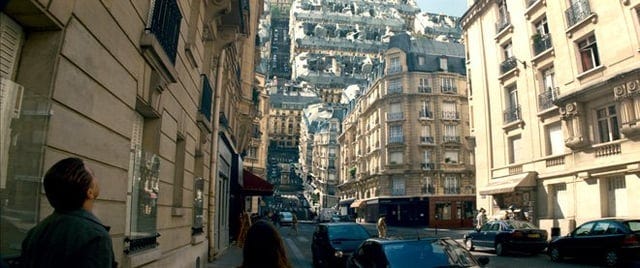
Nolan builds dream logic better than anyone ever has on screen. The dream layers are beautifully designed. Each level down runs on a different clock, at a different speed, with different physics and different stakes. The surface level is a rainy city chase. Below that, a hotel. Below that, a snow fortress. Each one has its own mood, its own color temperature, its own tempo of violence. Nolan cuts between them to build tension, and it works because the rules are so clearly established that you always know where you are and what’s at risk, even when three realities are unraveling at once.
COBB: They say we only use a fraction of our brain’s true potential. Now that’s when we’re awake. When we’re asleep, we can do almost anything.
The texture of the dreams are enticing. His dreams don’t look like acid trips and break immersion. They look like reality with one wrong detail, like a city that folds over on itself while people keep walking, like a staircase that goes up forever, like a hotel hallway that won’t stay level. They feel the way dreams actually feel: plausible in the moment, insane in retrospect .
Even the scenes that aren’t supposed to be dreams feel dreamlike. The Mombasa sequence, where Cobb is running through narrow corridors that seem to close in around him, has the quality of a chase you’d have in sleep, the walls tightening, the exits shrinking. The whole movie lives in that space between waking and dreaming, and after enough viewings, you start to wonder if that’s the point. This is, of course, the great debate. The spinning top at the end. Did it fall? The wedding ring. The children’s clothes. Thousands of frame-by-frame analyses exist. Nolan built a film that turns its audience into investigators after the credits.
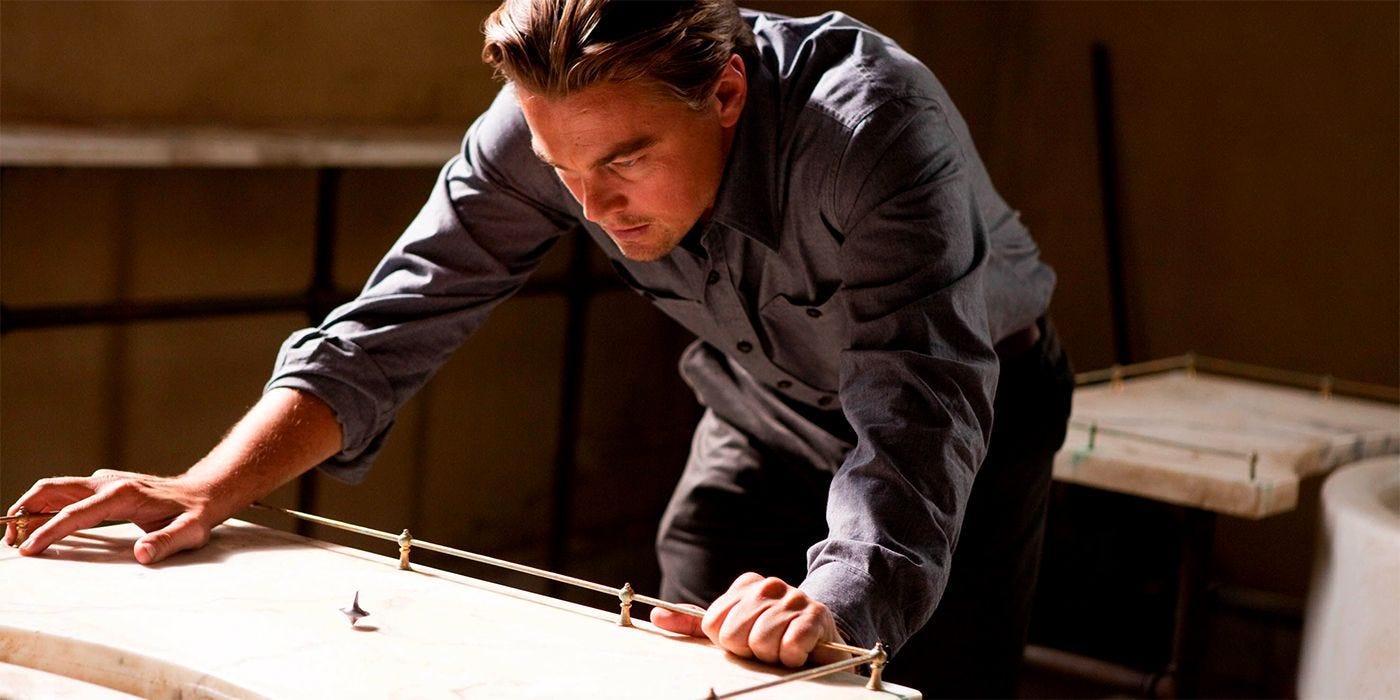
DiCaprio is the reason the investigation matters. The emotional centerpiece of the movie. Without him, the dream mechanics would have fallen flat. He brings grief. Real, heavy, specific grief. Cobb lost his wife, and he carries her with him into every dream like a virus he can’t shake. DiCaprio plays this with a rawness that came from pushing Nolan behind the scenes to humanize what could have been a cold cerebral exercise. You can feel the tension between Nolan’s architectural instincts and DiCaprio’s emotional ones, and the movie is all the more extraordinary because of it. You can feel his pain in the scene where Cobb sees Mal commit suicide.
There’s a physical resemblance between DiCaprio and Nolan himself that I can’t quite shake. Whether it’s intentional or not, it adds a layer. The director as the dreamer. The actor as his projection. The audience as the mark.
The rest of the cast fills in every gap. Joseph Gordon-Levitt plays Arthur with a lightness that makes his action sequences feel effortless. The hallway fight, where he’s battling a man in a corridor that rotates like a washing machine, is one of the great practical stunts in the history of cinema. Gordon-Levitt sells every second of it with the athleticism of someone who looks like they genuinely enjoy getting thrown into walls.
Tom Hardy, as Eames the forger, brings a warmth and humor that the movie desperately needs. He’s the guy cracking jokes at the edge of the abyss, and Hardy plays him with such easy charisma that you wish he had more screen time.
ARTHUR: Eames, I am impressed.
EAMES: Your condescension, as always, is much appreciated, Arthur, thank you.
Ellen Page grounds Cobb as Ariadne, the architect, and her wide-eyed curiosity is the audience’s way in. Ken Watanabe is a perfect fit as Saito. Murphy is phenomenal as Robert Fischer, the man who wants to create his own legacy.

EAMES: "You mustn't be afraid to dream a little bigger, darling."
Now. The soundtrack.
Hans Zimmer’s score for Inception might be the single best piece of film music composed in history, and I say that knowing full well what Zimmer did with Interstellar a few years later. Where the Dark Knight trilogy leaned on heavy, grinding bass, Inception goes somewhere else with the same bass. Brass swells that feel like Parisian architecture. Strings that ache. And then there’s the piece at the center of the sound design: Édith Piaf’s “Non, je ne regrette rien” slowed down across dream layers, warped and stretched until it becomes the foghorn-like blasts that define the movie’s sonic identity.
The score and the sound design are inseparable here. They’re the same thing at different speeds. The way sound warps in the dream layers, the way a kick in one level manifests as a shudder in another, the way the Piaf track drifts in and out of the dream logic like a signal from another frequency, and gets integrated into the soundtrack itself. This is meticulous work.
Specific tracks stay with me the way scenes do. “Mombasa” is pure momentum. “One Simple Idea” is my personal favorite, used during the planning sequence it has the energy of a team that knows exactly what they’re about to do and can’t wait to start.
“Old Souls” and “Waiting for a Train” are devastating, quiet pieces that reflect the tragedy of Cobb and Mal’s story. “Dream Is Collapsing” does exactly what the title says. “Radical Notion” is incredible during the movie’s climax in the final dream level. That’s before we get into Hans Zimmer’s recording sessions, which has even more music never released in the soundtrack, and pieces like “Mr. Charles” or “Strategy”
And “Time,” which everyone knows, which plays over the ending and has been used in a thousand YouTube videos since, is somehow the least interesting track on the album. Not because it’s bad. Because everything around it is even better for deep work. This is a soundtrack I’ve listened to hundreds of times while working, studying, thinking. It puts you in a flow state. It makes you feel like you’re planning something important. Very few scores do that outside the context of their film.
Visually, Nolan and cinematographer Wally Pfister opt for cool blues with handheld cameras that give the image a slight blur, a slight instability. It’s not the crisp, locked-down framing you’d expect from a movie this expensive. But it works because it mirrors the imprecision of dream recall. You’re never quite sure if what you’re seeing is perfectly real. The color palette shifts between layers: warmer in Mombasa, sterile in the snow, grey and rain-soaked on the surface. Each layer has its own visual grammar, and you absorb it without thinking about it, which is exactly how dreams deliver information.
COBB: [notices that he’s being followed] That price on my head, was that dead or alive?
EAMES: Not sure. See if he starts shooting.
The pacing is relentless in the best way. This is one of the great movies that never loses you. Not a scene. Not a beat. The tension ratchets from the opening and doesn’t let up. Once they get into the dream, the sequence where the team realizes they’re up against militarized subconscious security, when DiCaprio turns on Gordon-Levitt with real anger, is close to the peak of the film’s intensity, and it comes well before the climax.
Nolan builds pressure the way the best stories do: by making every piece of new information raise the stakes instead of just adding complexity. You’re always learning something and always worried about something, and those two feelings feed each other until the final act becomes almost unbearable in the best possible way.
Arthur: So, once we’ve made the plant, how do we go out? Hope you have something more elegant in mind than shooting me in the head?
Cobb: A kick.
Ariadne: What’s a kick?
Eames: This, Ariadne, would be a kick
[kicks the leg of the chair Arthur’s swinging at]
Arthur: [finds his balance and glares at Eames]
Inception is a philosophy movie wearing a Bond suit. One of Nolan’s finest tricks. It’s got the globe-trotting locations, the sharp-dressed operatives, the ticking clocks, the gunfights in snow fortresses. It moves like a spy thriller. It feels like a heist. But look beyond the set pieces and you’re watching a film about the nature of reality, about whether we can trust our own minds, about what separates a genuine belief from one that was put there by someone else. Most films that ask those questions forget to be exciting. Most films that are this exciting don’t bother asking. Nolan figured out that if you disguise philosophy as espionage, people will sit through two and a half hours of it and leave wanting more.
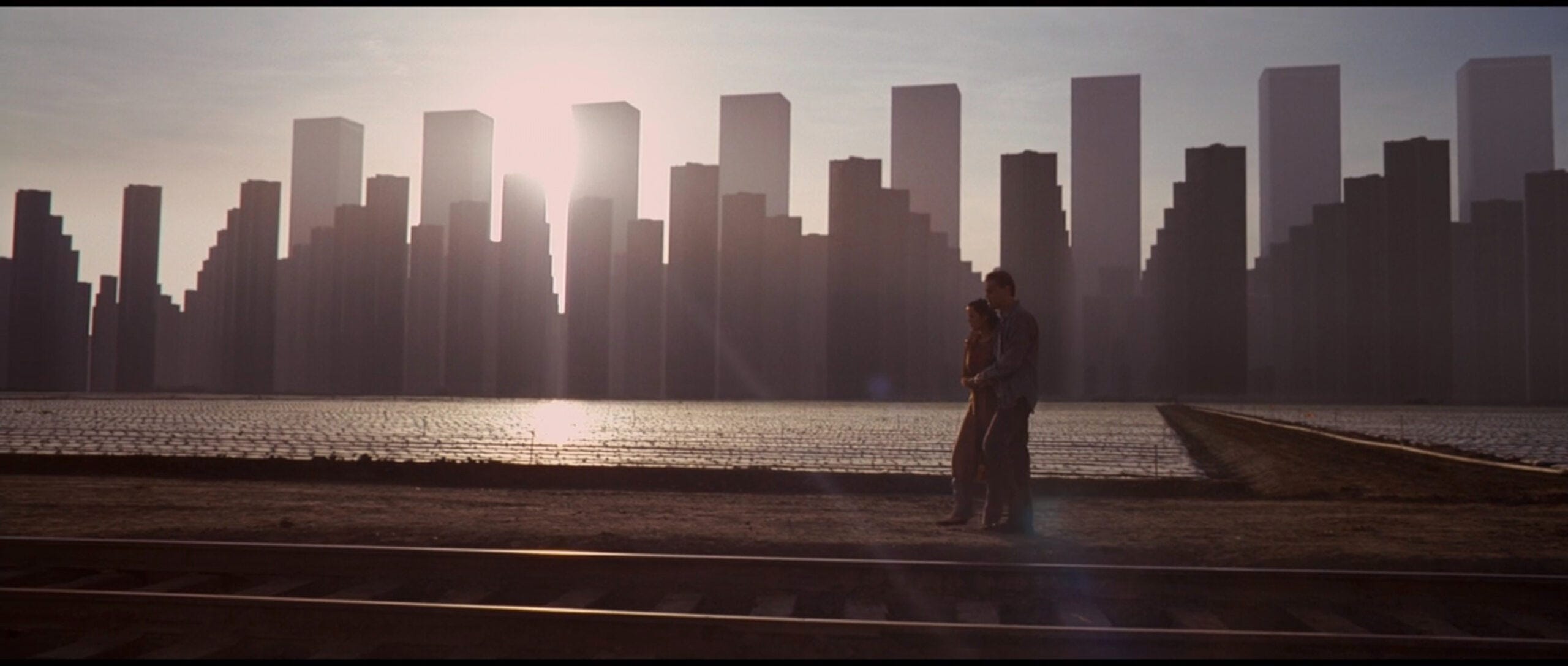
Inception is about how stories infiltrate us. Cobb’s team does what filmmakers do. The architect builds the world. The forger plays a role. The chemist handles the medium. The point man manages logistics. And the extractor, the director, orchestrates it all so that the target walks away believing a new idea was their own. Nolan is telling you, in the most entertaining way possible, that this is what movies do to you. They plant ideas. They make foreign emotions feel native. They’re psychological operations dressed as entertainment. It’s a remarkably honest thing to put in a blockbuster, and most audiences absorb it without ever consciously registering it, which is, of course, the whole point.
I keep coming back to this movie because it rewards obsession. Every rewatch surfaces something new, some detail in the background, some line reading that means something different now, some structural echo between dream layers. It’s dense without being difficult. The making of this movie was something to behold. The real sets. The hallway fight. The train in LA. The castle sequence. The use of practical effects elevates the whole thing. There’s a featurette that’s over 1 hour in length that used to be available on YouTube in multiple parts; it’s gone now, but here is part 1 and part 2 of the closest thing I can find.
Maurice Fischer: [Robert opens the vault to see Maurice on his death bed struggling to say something] Disa... disap... disappointed
Fischer: I know, Dad. I know you were disappointed I couldn’t be you.
Maurice Fischer: No. No, no. I was disappointed... that you tried.
[Robert opens the safe to find the new Last Will and Testament along with the pinwheel from when he was a kid. The inception has worked]
Anyone can watch Inception. Nolan made a $160 million original science fiction film about dream architecture and subliminal persuasion, and it grossed $800 million worldwide. That number matters because it proved something the industry keeps trying to forget: audiences will show up for ambitious, original, complicated work if you make it thrilling enough. If you give them characters they care about. If you build dreams that feel like dreams.
The only viewers who might struggle are those who need their stories rooted firmly in the real. If you can’t suspend disbelief for the mechanics, the exposition in the first act will feel like homework. Everyone else will find something here. Dreamers, planners, grief-carriers, puzzle-solvers, anyone who’s ever woken from a dream and spent the morning trying to remember why it mattered.

This was peak Nolan. He’d just made The Dark Knight and proved he could turn a comic book into a crime epic. Inception proved something harder: that he could make the inside of his own head into a worldwide event. He’s made great films since, Interstellar and Oppenheimer chief among them. But this is the one where all his lucky stars lined up at once, where the ending became a cultural argument. It stands alone.
The top wobbles. Cut to black. And you’re still thinking about it, years later. Are you sure the idea is even yours?